US Machine Tool Orders Just Hit Their Third-Highest Month on Record. What Does That Mean for Your Machined-Parts Lead Times?
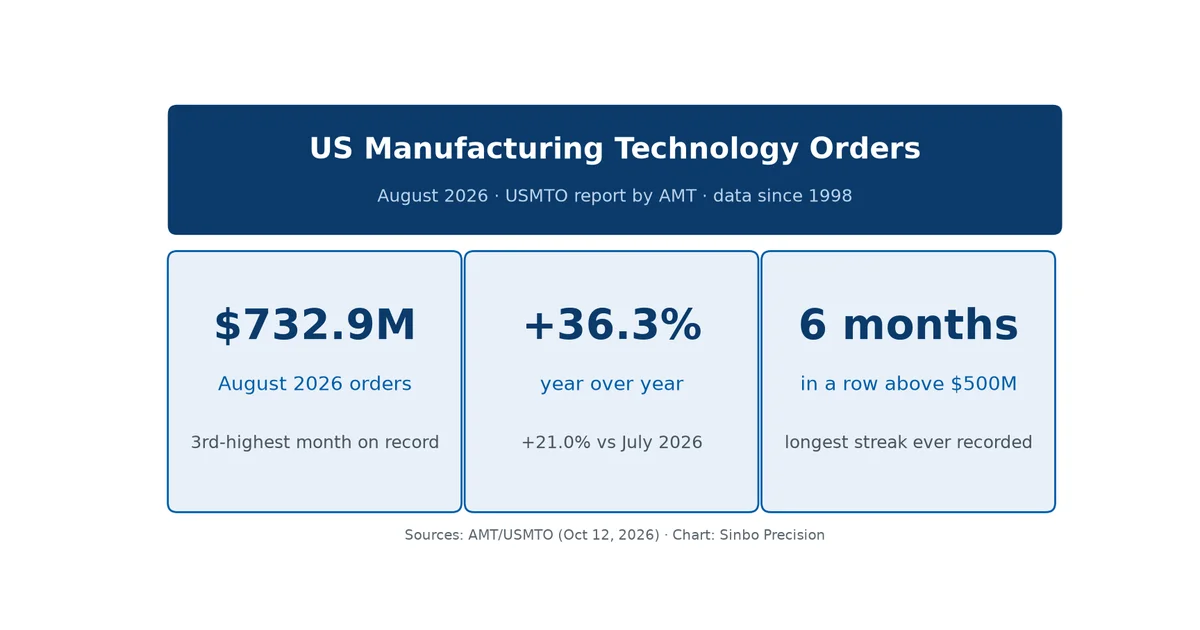
US manufacturing technology orders, August 2026: $732.9M, +36.3% YoY, third-highest month in USMTO data going back to 1998
US orders of metalworking machinery reached $732.9 million in August 2026 — the third-highest monthly total ever recorded, on the longest streak above $500 million since the data began. For buyers of machined parts, an equipment boom is not background noise: it moves capacity, lead times and quote behavior in ways you can plan around.
What the Numbers Actually Say
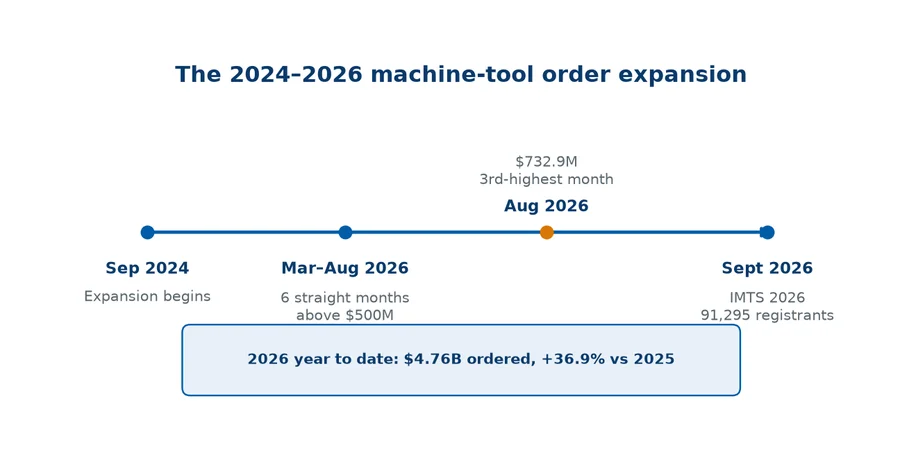
The US Manufacturing Technology Orders report published by AMT — The Association For Manufacturing Technology put August 2026 orders at $732.9 million, the third-highest monthly total ever recorded. That is 21.0% above July 2026 and 36.3% above August 2025. Through the first 8 months of 2026, orders totaled $4.76 billion, up 36.9% over the same period of 2025.
One detail matters more than the headline. The rally now includes 6 consecutive months above $500 million — the longest such streak since USMTO began collecting the data in 1998. A single big month can be one factory buying one production line. Six months in a row is an industry-wide capital-spending cycle, and it started back in September 2024.
Why Are Shops Buying So Much Equipment Right Now?
Two forces are stacking. First, order values have grown nearly 3 times faster than order units since the expansion began — which means buyers are not just ordering more machines, they are ordering more expensive, more automated machines. Aerospace, a high-value-equipment sector, has taken a growing share of total orders through the whole rally.
Second, the mix of who is buying just changed. The expansion up to now was led by OEMs, who buy heavily automated machinery. In August 2026, orders from contract machine shops grew faster than the overall market for the first time in this cycle — on the heels of IMTS 2026, which drew 91,295 registrants and 1,788 exhibiting companies to Chicago. When job shops — the shops that machine parts for customers like you — start buying, they are buying capacity specifically to take on outside work.
The demand side is expanding at the same time: the ISM Manufacturing PMI for October 2026 came in at 55.5%, comfortably in expansion territory. Machines are being bought into a rising market, not ahead of a collapsing one.
What an Equipment Boom Does to Your Lead Times
Here is the part buyers feel. A machine that is ordered this quarter is not cutting parts this quarter. Machine tools themselves carry delivery times; then come foundation work, installation, commissioning and process qualification — a newly delivered machining center typically takes 6 to 12 months from arrival to stable production. During that window the shop is carrying the invoice without the capacity.
That produces a predictable squeeze: in the first phase of an equipment boom, everyone orders parts into capacity that has not arrived yet. Queue times lengthen first at the high-end end of the market — 5-axis cells, multi-pallet automation, tight-tolerance work — because that is where the orders are concentrating. If your parts need those configurations, the lead-time pressure on your quotes is real and it arrives before any new capacity does.
What It Does to Quotes
In the short run, tight capacity pushes hourly rates up — quotes get firmer, expedite fees appear, and the shops with open capacity get pickier about which jobs they take. In the medium run the logic reverses: the new machines being installed are heavily automated, and automation cuts the labour content per part. A shop running lights-out pallet cells quotes differently from the same shop running three shifts of operators.
The practical reading for a buyer: quote firmness over the next two quarters, quote improvement after that — but only with shops that are actually installing the equipment they ordered. That is a question you can ask, and the next section is what to ask.
What to Ask a Supplier About Capacity Before You Place the Order
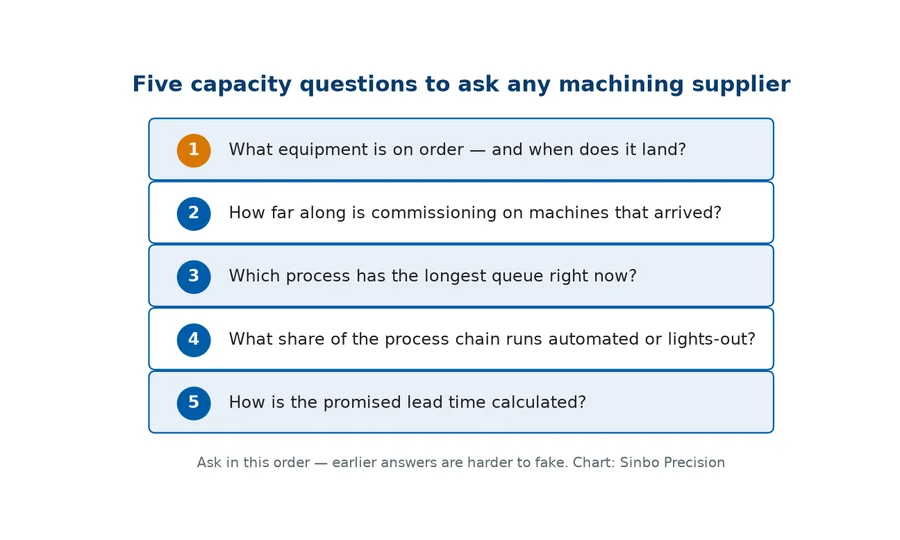
Machine-tool order data is public and monthly. Use it to calibrate how you talk to suppliers — including us. Five questions that separate a prepared shop from an optimistic one:
- What equipment is on order, and when does it land? A dated purchase order is an answer; "we are planning to invest" is not.
- How far along is commissioning on machines that already arrived? Installed-but-qualifying capacity is not yet capacity you can book.
- Which of your processes have the longest queue right now? Every shop has one bottleneck cell; quotes that ignore it are guesses.
- What share of the relevant process chain runs automated or lights-out? This tells you whether their cost base improves when the new machines land.
- How is the promised lead time calculated? A queue-based answer ("3 weeks of WIP plus 4 days of run time") survives contact with reality; a round number does not.
The Honest Summary
A record order month does not mean prices are about to explode, and it does not mean a golden age of cheap capacity is around the corner. It means the industry is in a genuine capital-spending cycle: $4.76 billion committed in 8 months, six straight months above half a billion, and contract shops — the people who machine your parts — have started buying for themselves.
For a buyer, the actionable version is simple. Expect lead-time pressure on high-end work while the equipment is in transit and being commissioned. Ask the five questions above and weight the answers by how verifiable they are. And treat shops that can tell you exactly what is on order, when it lands, and what it will run as the ones to grow with — that transparency is what the data says matters in this cycle.
Frequently Asked Questions
Is this machine-tool order boom a bubble about to burst?
The data does not say bubble. Order values are growing about 3 times faster than units, which points to automation-heavy buying by well-capitalized buyers — OEMs through most of the cycle, now joined by contract shops. Demand-side indicators agree: the October 2026 ISM Manufacturing PMI was 55.5%, in expansion. Bubbles look like units spiking on cheap credit into falling demand; this rally is the opposite profile. It can still cool — every cycle does — but a pullback from record levels is not the same as a collapse.
Should I lock in pricing now before capacity tightens further?
Split the decision. For parts that run on high-end configurations — 5-axis, multi-pallet, tight-tolerance work — the near-term direction of lead times is up while ordered capacity is in transit and commissioning, so earlier commitments and longer-horizon agreements are worth negotiating now. For simpler 3-axis work, quoting is likely to stay competitive, and automation installed over the coming year tends to improve unit costs after commissioning. Lock structure where capacity is scarce; stay flexible where it is not.
Does a US machine-tool boom matter if I source parts from China?
Yes, in two ways. Directly: machine tools are a global supply chain, and when US and European buyers absorb output, delivery times for the same machines lengthen everywhere — including for Chinese suppliers investing in the same automation. Indirectly: your Chinese suppliers face the same questions about ordered capacity, commissioning queues and automation share, and the same five questions apply to them. Ask them in the same order.
Sources
- AMT — The Association For Manufacturing Technology, "Rally in Machinery Orders Extends onto the Heels of IMTS 2026" (Oct 12, 2026) — USMTO report: August 2026 orders $732.9M (third-highest month recorded), +21.0% MoM, +36.3% YoY; 2026 YTD $4.76B, +36.9%; six consecutive months above $500M; expansion since September 2024; order values growing ~3x faster than units; contract machine shop orders outgrew the market in August 2026; IMTS 2026 drew 91,295 registrants and 1,788 exhibitors.
- ISM Manufacturing PMI, October 2026 (PR Newswire release) — October 2026 ISM Manufacturing PMI at 55.5%, indicating expansion in US factory activity.
USMTO figures are based on data reported by companies participating in the USMTO program. Order data is a leading indicator of capacity investment, not a forecast of prices; treat it as one input among several when planning sourcing decisions.
Related Reading
EN 10204 Material Certificates: A Buyer’s Guide
What the 2.1, 3.1 and 3.2 certificate types actually mean, and which one your part needs.
Aluminium CNC Machined Parts
Alloys we machine, the tempers we run, and the certification that comes with each order.
CNC Machining Services
3-axis, 4-axis and 5-axis milling and turning capabilities, tolerances and typical lead times.