6061 vs 7075 Aluminum: How to Choose for CNC Parts
The aluminum alloy list runs to dozens of grades, but in day-to-day purchasing about 90% of machined
parts use only two of them: 6061-T6 and 7075-T6. They are both aluminum, the names differ by
one digit, and many buyers default to the more expensive one. The result is a 30%–60% higher
material bill for performance the part never uses — or the opposite mistake, where a 7075 part
was needed and 6061 was specified, and the weakness only shows up at assembly.
This article puts the two grades side by side and gives you rules you can apply directly.
The Short Answer
- Most parts are fine in 6061-T6, which also welds better, resists corrosion better, machines
better and costs less. - Use 7075-T6 only when the load genuinely demands the higher yield strength and there is no
welding or corrosive environment. If stress corrosion cracking is a concern, specify
7075-T73 rather than T6. - Choosing on weight alone is wrong. 7075 is only about 4% denser than 6061, so identical
volumes save almost nothing. Real weight saving comes from making the part thinner — and
that is exactly where 7075 earns its place.
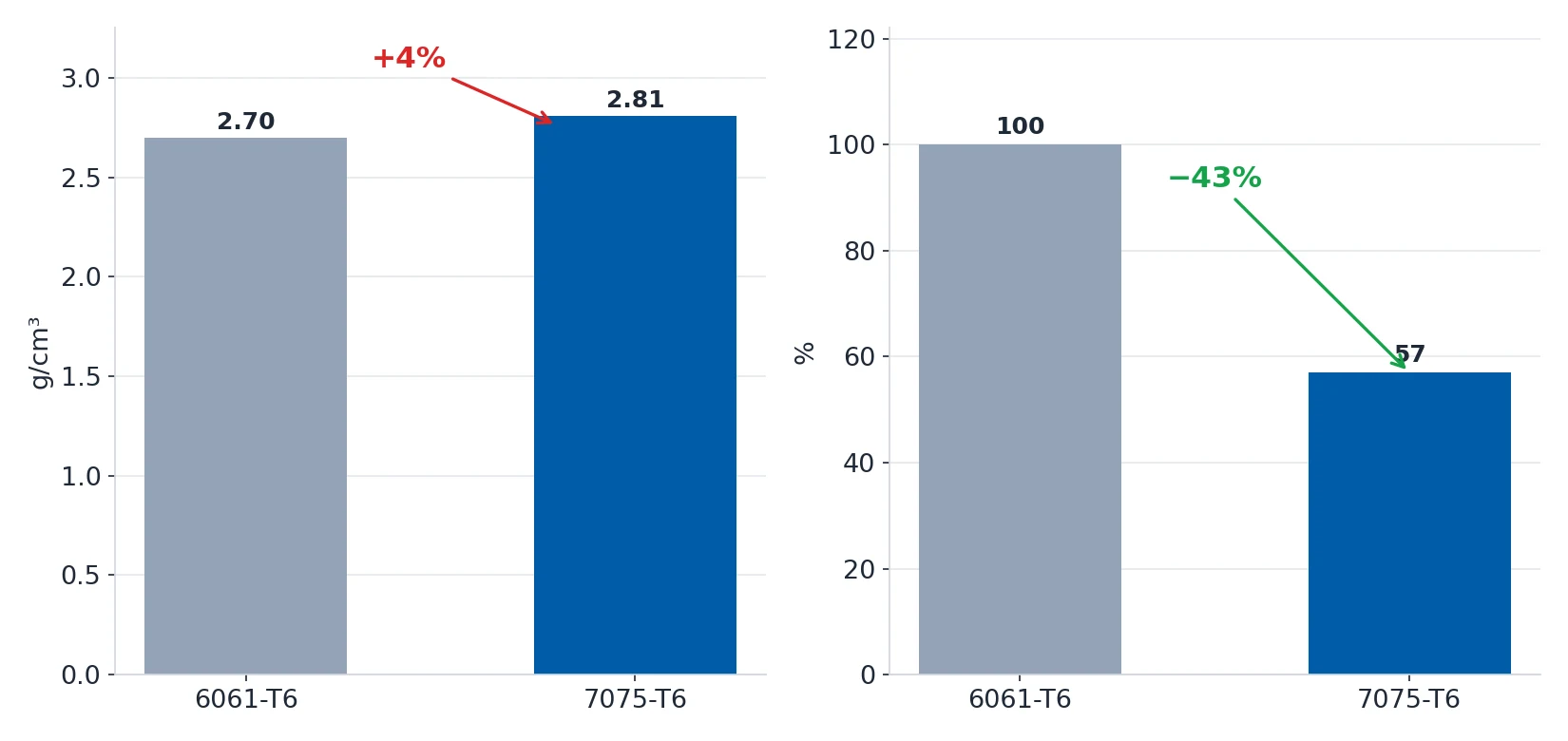
Density differs by only 4%, but a 7075-T6 part made thinner for the same load is about 43% lighter.
Property Comparison
| Property | 6061-T6 | 7075-T6 | Note |
|---|---|---|---|
| Yield strength | 276 MPa (40 ksi) | 503 MPa (73 ksi) | 7075 is ~82% higher — its one decisive advantage |
| Tensile strength | 310 MPa (45 ksi) | 572 MPa (83 ksi) | 7075 is ~84% higher |
| Elastic modulus | 68.9 GPa | 71.7 GPa | Nearly identical — stiffness is not set by the grade |
| Density | 2.70 g/cm³ | 2.81 g/cm³ | 4% apart, not the main difference |
| Fatigue strength (10⁷ cycles) | ~138 MPa | ~138 MPa | Essentially the same — high strength does not mean higher fatigue life |
| Fracture toughness KIC | ~29 MPa√m | ~20 MPa√m | 7075 is more brittle, with lower damage tolerance |
| Weldability | Good | Poor | 7075 welds crack easily |
| Stress corrosion cracking | Not susceptible | Susceptible in T6 | 7075-T73 / T74 improve it markedly |
| Corrosion resistance | Good | Poor | 7075 develops white corrosion (zinc precipitation) |
| Machinability | Good | Fairly poor | 7075 cuts harder, wears tooling faster and is prone to built-up edge |
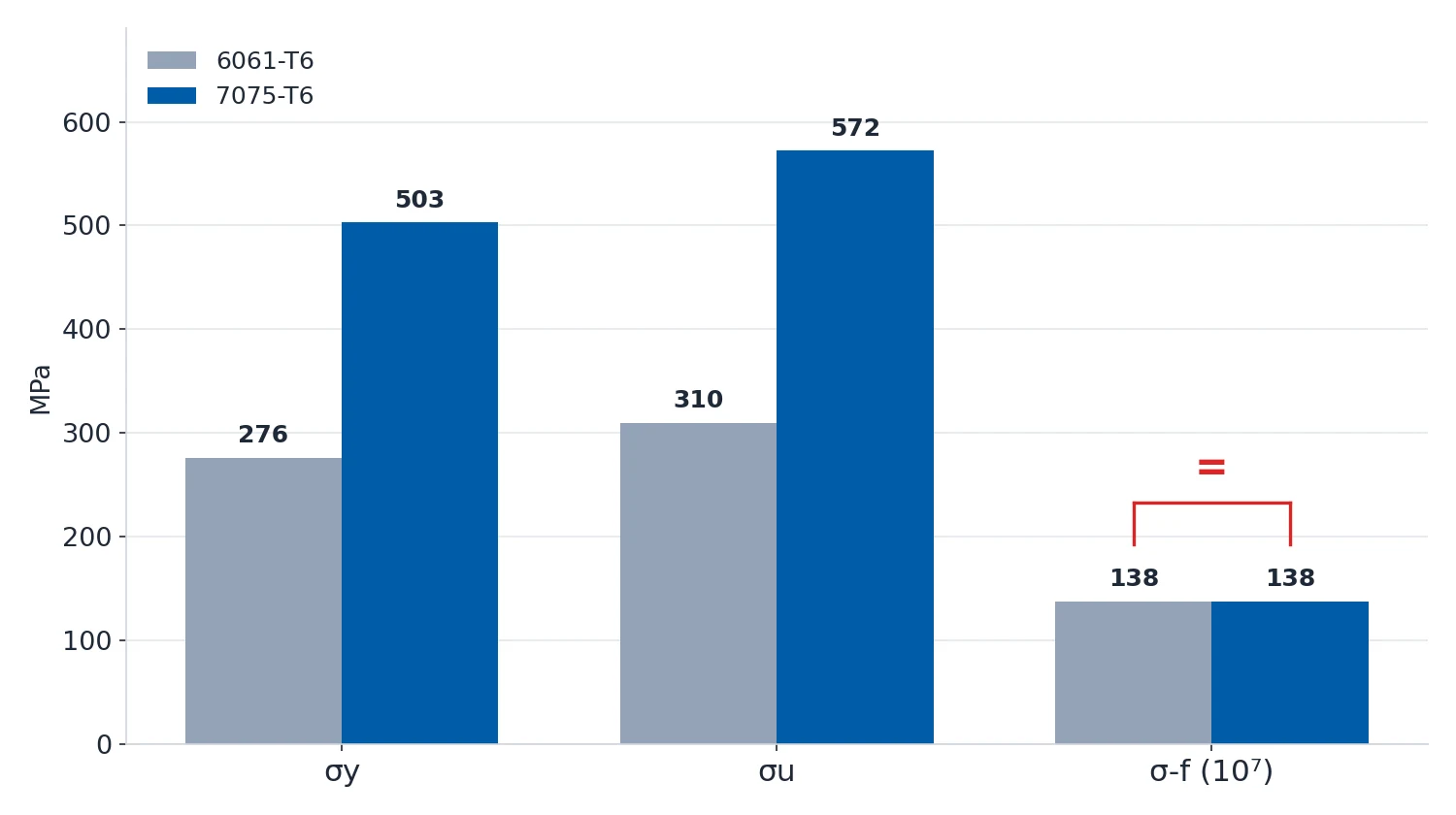
The row people most often miss is "fatigue strength." Many engineers assume the stronger
alloy lasts longer and pick 7075. But the fatigue limit of aluminum is almost independent of
grade: 6061-T6 and 7075-T6 are both around 138 MPa. What actually decides fatigue life is
stress concentration, surface finish and residual stress. If your part is a repeatedly
loaded joint, upgrading the alloy often does less than adding a fillet, lowering surface
roughness and controlling stress relief.
When You Genuinely Need 7075
The yield-strength advantage of 7075 is real in these cases:
- High-load structural parts: aerospace brackets, robot joint links, racing suspension
components, drone airframes. With the same load section, 7075 lets you reduce wall thickness,
which is where the actual weight saving comes from. - Stiff thin-walled parts — with one caveat: the two alloys have nearly the same elastic
modulus, so the stiffness of a thin wall comes from geometry and section inertia, not from the
alloy. 7075's role here is that it "allows thin without collapsing". - Hard, wear-resistant parts: 7075-T6 is about 150 HB, against roughly 95 HB for 6061-T6.

7075-T7351 machined housing - the class of part where the higher yield strength earns its place.
Three hard warnings when you do specify it:
- If there is welding, go back to 6061. The Al-Zn-Mg-Cu system in 7075 cracks readily when
welded, and the strength loss afterwards is large and unpredictable. If the design cannot avoid
welding, 6061 is the answer without hesitation. -
For outdoor or marine service choose T73/T74, not T6. 7075-T6 is vulnerable to stress
corrosion cracking in the presence of chlorides or residual stress. T73 (artificially aged for
stress relief) gives up about 8% strength and buys a large improvement in cracking resistance.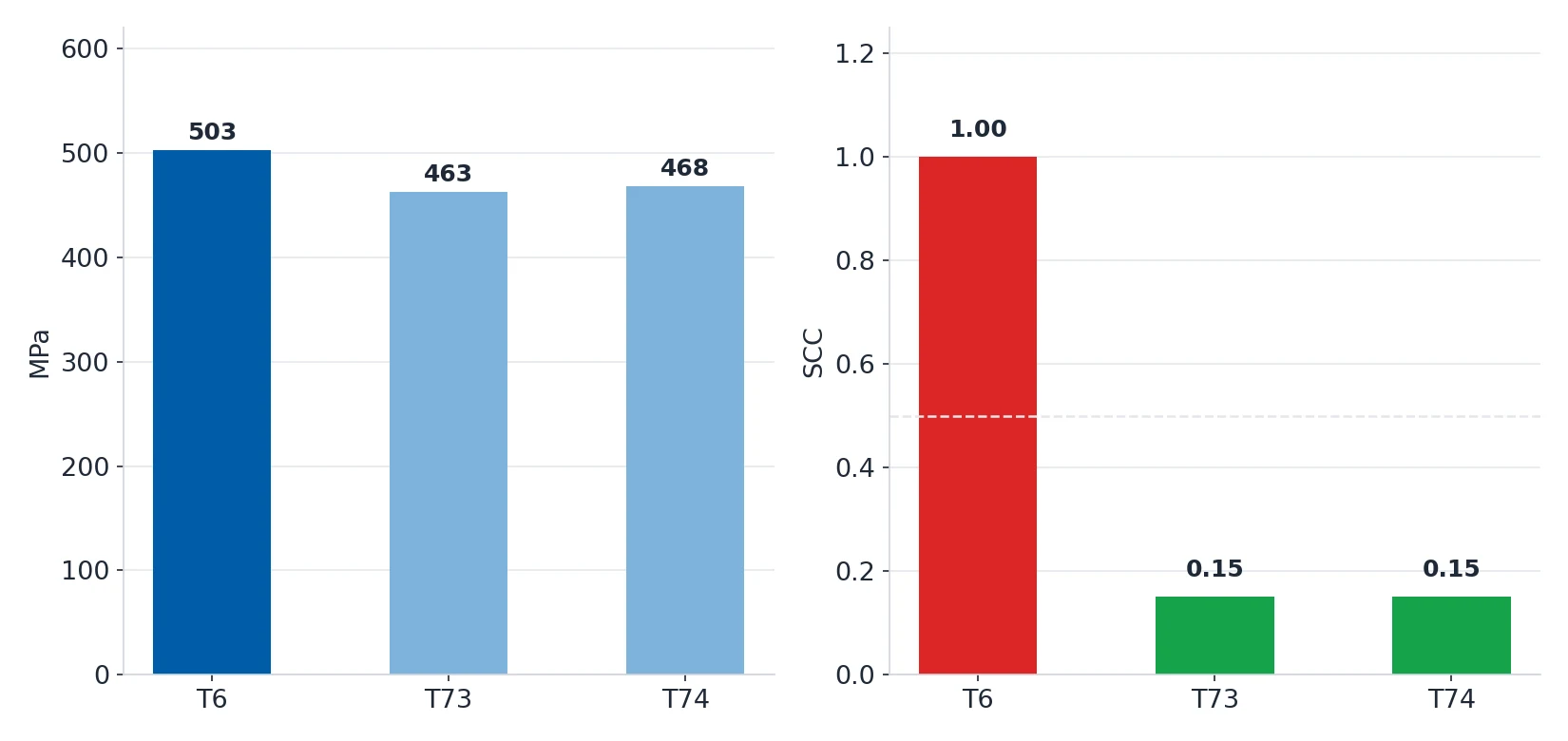
T73 and T74 give up about 8% of yield strength and remove most of the stress corrosion cracking risk of T6. -
Mind the direction of rolled plate. The through-thickness (Z) properties of 7075 plate drop
noticeably, so any part loaded perpendicular to the plate face needs this called out.
When 6061 Is the Better Choice
In these situations 7075 brings no benefit and creates problems:

- Welded assemblies: 6061 is the standard weldable aluminum.
- Wet, salt-spray or chemical environments: 6061 resists corrosion markedly better than
7075. - Medical and food-contact parts: 6061 has a mature grade system with clear certification
and traceability; the zinc and copper in 7075 need separate evaluation under some regulations. - Complex deep-cavity or thin-walled parts: 7075 cuts harder, tooling wears faster, and the
added labor often cancels out the material price difference. - Cost-sensitive parts at moderate loads — by far the most common case.
Writing the Specification So It Cannot Go Wrong
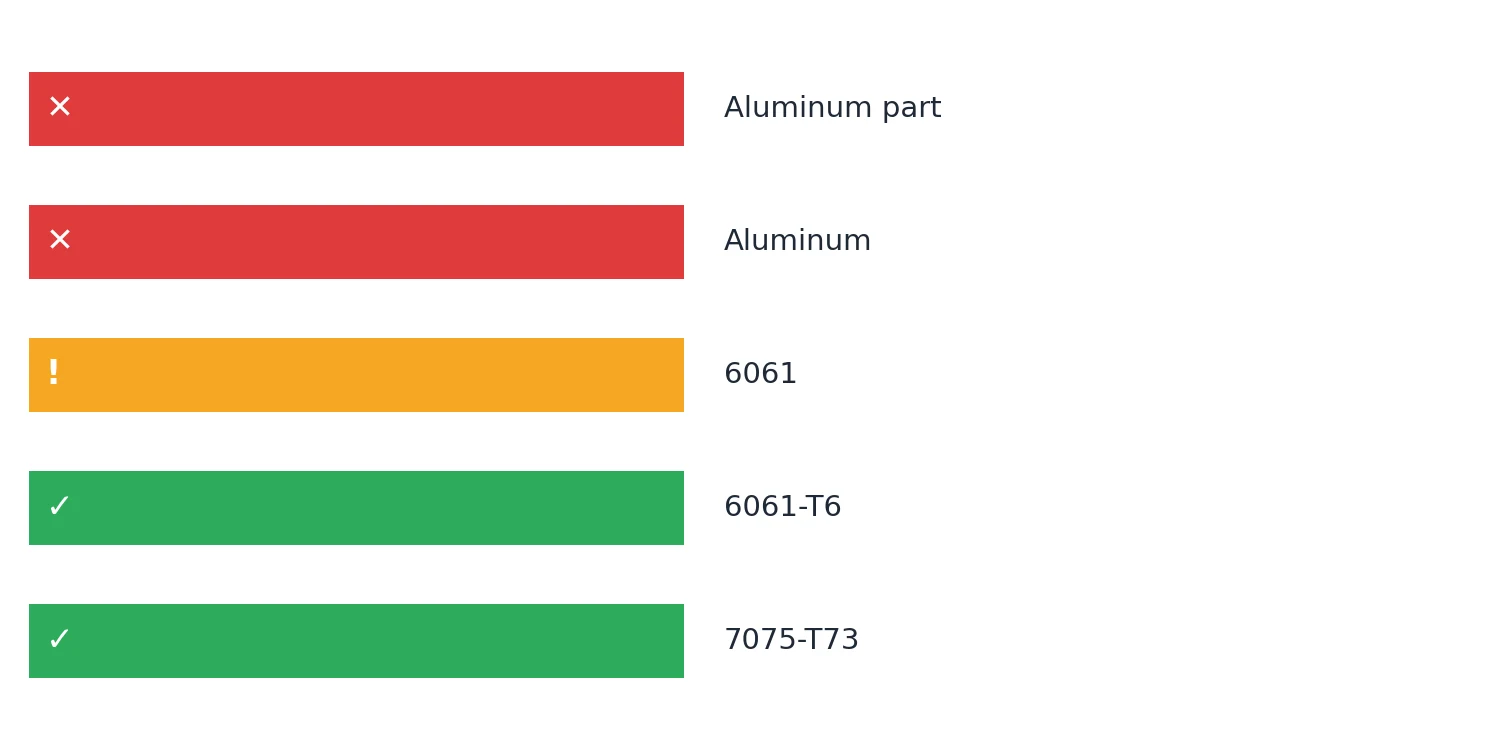
Many RFQs say only "aluminum part," which lets every supplier quote a different grade and a
different price. The correct form is alloy plus temper:
| Written as | Acceptable | Problem |
|---|---|---|
| "Aluminum part" | ❌ | Neither alloy nor temper is fixed — anyone can quote it |
| "Aluminum" | ❌ | Same, and no temper at all |
| "6061" | ⚠️ | Alloy is right, temper is not (T6 / T651 / T7351 differ a lot) |
| "6061-T6" | ✅ | Alloy and temper, unambiguous |
| "7075-T73" | ✅ | Alloy and temper, and stress-corrosion cracking already considered |
Two additions:
- State plate and extrusion separately. 6061-T651 is the common plate condition (artificially
aged, dimensionally stable); 6061-T6 is more typical of extrusions or unaged plate. - Fix the surface finish together with the alloy. Hard anodizing a 7075 part raises residual
stress further, so the correct order is: choose T73 first, then anodize to the specification that
applies to that temper.

Anodized 7075 part: the finish adds residual stress, which is why the temper has to be chosen first.
A Decision Order You Can Follow
When a drawing lands on your desk, ask four questions in this order and the alloy follows:
- Is there welding? Yes → 6061.
- Will it live outdoors, in salt spray or in chemicals? Yes → 6061; if 7075 is otherwise
required, use T73/T74. - Is the primary load static or repeatedly cyclic? Cyclic and the fatigue calculation already
passes → 7075-T6 is allowed. If the fatigue calculation does not pass, fix the geometry
first (add radii, remove sharp corners, lower surface roughness) rather than switching alloy. - None of the above, and the part needs to be thinner and lighter? Yes → 7075-T6; otherwise →
6061-T6.
How We Help With This Decision
Alloy confirmation is a fixed step in the DFM review we run between receiving a drawing and
returning a quotation.

Our engineers check:
- Whether the drawing states alloy and temper. Where it does not, we propose one for the
application and mark it on the quotation; - Whether welding, heat treatment and surface finishing requirements conflict with one another
(7075-T6 anodizing plus outdoor service, for example); - Whether the strength requirement really needs 7075 — if 6061 meets it, we tell you what you save;
- The tooling and labor plan for thin-walled and deep-cavity parts, which determines how much more
a 7075 part actually costs to machine.
If you have an aluminum part you are currently comparing quotes for, send the file over and we will
run an alloy and process feasibility check before you quote, so you are not guessing between two
grades.
Property values are typical figures from public material handbooks (ASM/MatWeb). Actual values vary
with product form and lot. Base engineering decisions on the material specification you hold and on
measured data, not on this table alone.