Aluminum vs Steel for CNC Machining: Cost and Performance
Aluminum and steel are the two default answers to "what should this part be made of", and most
drawings pick one without explaining why. The short version: aluminum wins on weight, on
machining cost and on anything that has to be welded; steel wins on wear, on stiffness at
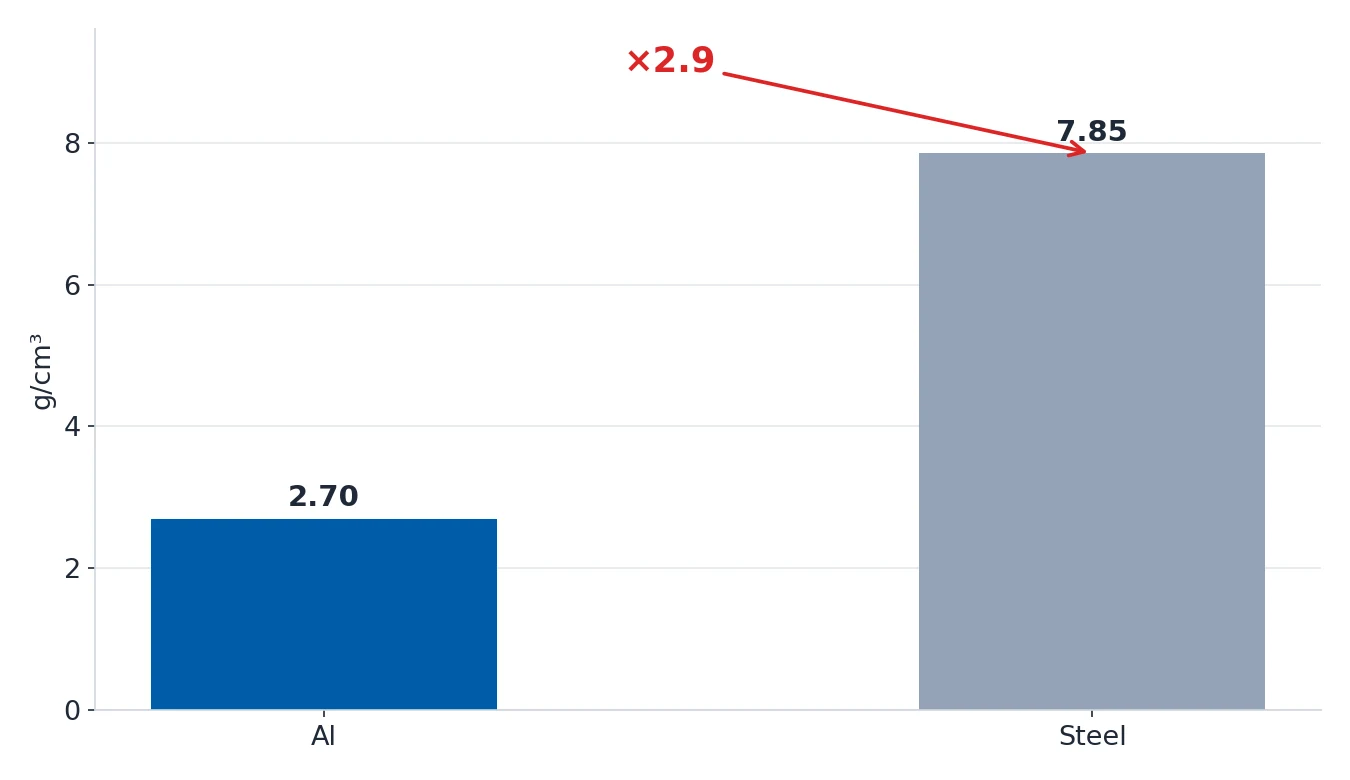
thickness and on anything that has to be hard. The density difference alone — 2.70 g/cm³
against 7.85 g/cm³, a factor of about 2.9 — settles a surprising number of drawings on its own.
This article puts the common grades side by side and gives you the decision rules.
The Short Answer
- Choose aluminum when the part is weight-sensitive, needs to be welded, must survive a wet or
corrosive environment, or is simply a high-volume part where cycle time and tooling cost
dominate. 6061-T6 is the default and covers most work. - Choose steel when the part takes impact, wears against another surface, needs to be hard or
strong in a small section, or runs next to heat. 1045 for general shafts and brackets, 4140
for parts that need heat treatment, 4340 when the load is high. - Do not judge on strength alone. Divide the tensile strength by the density and the ranking
changes: 6061-T6 reaches about 115 MPa per g/cm³, while even 4340 — the strongest common alloy
steel in the table below — reaches about 95. Aluminum has the better strength-to-weight ratio
at almost every grade. - Hardness and wear resistance is where steel has no answer. Aluminum tops out around
95–150 HB; 4140 and 4340 can be heat treated to 38 and 50 HRC, and D2 to 62 HRC.
Property Comparison
The numbers below are the values already published on the material pages of this site, so you can
check any of them against its own detail page.
| Property | 6061-T6 | 7075-T6 | 5052-H32 | 6082-T6 | 1045 | 4140 | 4340 |
|---|---|---|---|---|---|---|---|
| Tensile strength (MPa) | 310 | 572 | 193 | 340 | 585 (annealed) | 655 (annealed) | 745 (annealed) |
| Yield strength (MPa) | 275 | 503 | 145 | 290 | — | — | — |
| Elongation | 12% | 11% | 12% | 10% | — | — | — |
| Density (g/cm³) | 2.70 | 2.81 | 2.68 | 2.71 | 7.85 | 7.85 | 7.85 |
| Hardness | 95 HB | 150 HB | 60 HB | 100 HB | max 35 HRC (H&T) | max 38 HRC (H&T) | max 50 HRC (H&T) |
| Machinability | Excellent | Good | Excellent | Excellent | Good | Good | Fair |
| Weldable | Yes | No | Yes | Yes | Yes | Preheat required | Preheat required |
| Relative material cost | 1.0x | 1.8–2.5x | — | — | — | — | — |
One caveat on the steel numbers: the tensile values for 1045, 4140 and 4340 are given in the
annealed condition, while the aluminum values are in their working condition (T6, H32). Heat
treated steel goes up substantially from the annealed figure — a 4340 quenched and tempered to
50 HRC is far stronger than the 745 MPa in the table. The comparison is still fair as a starting
point, but do not use it as your design allowables.
Specific Strength: Where Aluminum Wins
The useful calculation is tensile strength divided by density. It tells you how much load a given
mass of material can carry, which is what a weight-sensitive design actually cares about.
| Grade | Tensile (MPa) | Density (g/cm³) | Specific tensile strength (MPa per g/cm³) |
|---|---|---|---|
| 6061-T6 | 310 | 2.70 | 114.8 |
| 6082-T6 | 340 | 2.71 | 125.5 |
| 2024-T4 | 469 | 2.78 | 168.7 |
| 7075-T6 | 572 | 2.81 | 203.6 |
| 1045 | 585 | 7.85 | 74.5 |
| 4140 | 655 | 7.85 | 83.4 |
| 4340 | 745 | 7.85 | 94.9 |
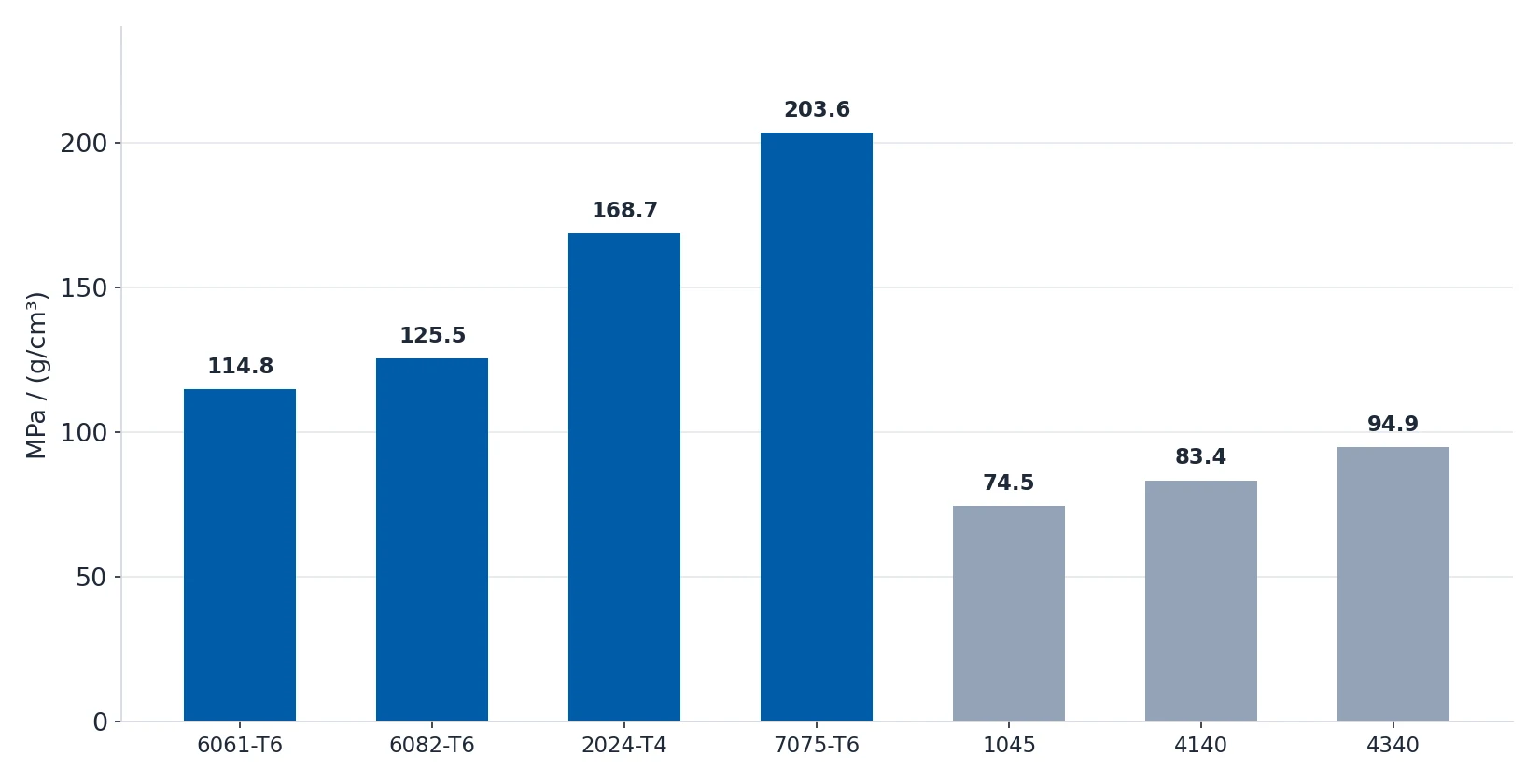 |
Two results are worth pausing on. First, 6061-T6 beats every one of these steel grades on
strength-to-weight. Second, 1045 — the most common mild steel on the shop floor — has a
specific strength of about 75, barely above 5052-H32 at 72, the weakest aluminum in the table.
That does not make 1045 a bad choice. It makes it a choice about stiffness, wear and cost, not
about strength per kilogram.
Where Steel Wins
There are four cases where aluminum is the wrong answer, and none of them are about weight.

- Wear against another surface. A bushing, a shaft, a wear plate or a seal face needs
hardness. Aluminum will not hold an edge; 4140 at 38 HRC or 4340 at 50 HRC will. - Small sections carrying high load. Aluminum needs roughly twice the section of steel to
carry the same load. If the geometry is fixed by something else — a mating part, a housing, a
standard flange — there may be no room for the thicker aluminum section. - Impact and shock. Aluminum has much lower fracture toughness and elongates before it
fails. Steel deforms and survives. - Heat. Steel handles temperature far better. For a part sitting next to a furnace, a die or
an engine, aluminum is the wrong family.
Machining Cost: What Actually Drives the Price
The material price is usually the smaller half of the quotation. These four items are usually
the larger half.

- Cycle time. Aluminum is rated "Excellent" for machinability on this site's material pages,
and 1045 and 4140 only "Good". In practice, an aluminum part with the same geometry runs
faster and can often run at higher feed rates. - Tool life. Aluminum is far kinder to inserts. 7075-T6, while still only rated "Good", cuts
harder and wears tooling noticeably faster. This is the most common reason a 7075 part ends
up costing more than the 6061 quote suggested. - Secondary operations. Aluminum welds and anodizes; steel often needs preheat before
welding and pickling or passivation after. Those are separate setup charges. - Deburring and finishing. Softer and more ductile material burrs differently and often needs
more hand work or a different deburring strategy.
Steel is not more expensive to machine in every case. 4340 and D2 are rated "Fair" and "Poor" for
machinability — D2 specifically because of its abrasive carbides — and those grades will cost
more in cycle time than 6061 will. The expensive combination is not "steel"; it is "hard,
abrasive tool steel with tight tolerances."
A Decision Order You Can Follow
When a drawing lands on your desk, ask these in order:

- Does the part rub against another surface, or need a hard edge? Yes → steel, and pick the
temper from the wear requirement rather than from the price. - Is the part weight-critical or handled a lot? Yes → aluminum, and check that the thickness
is still manufacturable. - Is there welding? If yes and the part is aluminum, 6061 or 6082 are the answers. If the
part must be steel, 1045 welds without preheat; 4140 and 4340 need it. - Does it sit near heat or need to survive impact? Yes → steel.
- None of the above? → 6061-T6. It is the cheapest path to a finished part in most cases.

5052-H32 parts: the aluminium grade to reach for when weldability and a marine environment matter.
How We Help With This Decision
Material selection is a fixed step in the DFM review we run between receiving a drawing and
returning a quotation. Our engineers check:

- Whether the drawing states alloy and condition. "Steel part" is not a specification;
1045 and 4340 are different products with different prices and different lead times. - Whether the surface finish and the material agree. Anodizing only applies to aluminum, and
hard anodizing on 7075 adds residual stress that must be accounted for. - Whether heat treatment is actually required, or whether it was copied from an older drawing.
It is one of the most expensive line items in a steel quotation and often unnecessary. - The tooling and cycle time plan, which is usually what turns "aluminum is cheaper" into a
number you can compare against the steel alternative.
If you have a part where the material choice is still open, send the file over and we will
return a quotation for both options so you can compare them on the same basis.
Property values are typical figures from public material handbooks (ASM/MatWeb) and from the
material pages of this site. Actual values vary with product form, condition and lot. Base
engineering decisions on the material specification you hold and on measured data, not on this
table alone.