Titanium Production Just Went Continuous. What Does GenX Mean for Buyers of Machined Titanium Parts?
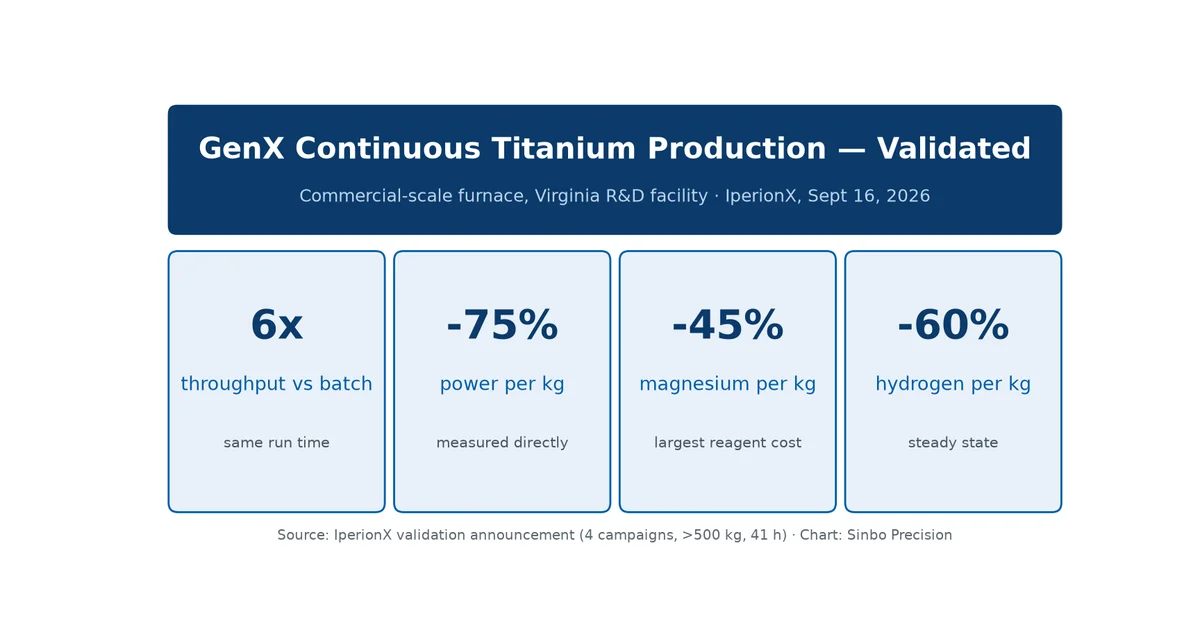
GenX continuous production vs the batch HAMR reference: 6x throughput, more than 75% less power, more than 45% less magnesium, more than 60% less hydrogen — measured data from IperionX validation runs
IperionX has validated continuous titanium powder production on a commercial-scale furnace in Virginia: more than 500 kg processed in 41 hours, at 6 times the throughput of the batch system, with more than 75% less power per kilogram. For buyers of machined titanium parts, this is the first credible path to a lower titanium cost curve — on a timeline measured in years, not weeks.
What Was Actually Validated
In an announcement published on September 16, 2026, IperionX said its next-generation GenX platform — a continuous version of its hydrogen-based HAMR titanium process — completed its first 4 production campaigns on the commercial-scale system at its Virginia R&D facility. Across 4 continuous runs totaling 41 hours, the furnace processed more than 500 kg of titanium powder at an average rate of about 12 kg per hour, with every valid sample meeting its oxygen specification.
The Numbers That Matter — and Their Exact Meaning
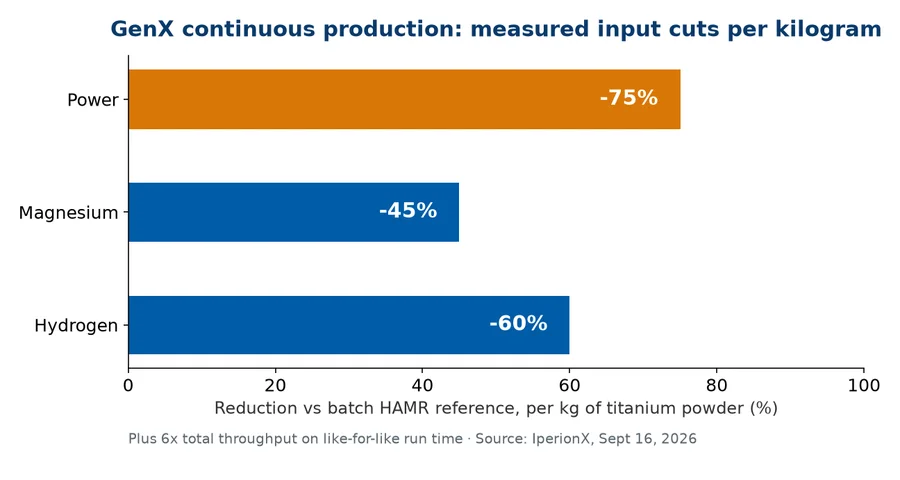
Three input figures stand out: power consumption reduced by more than 75%, magnesium use down more than 45%, and hydrogen use down more than 60% per kilogram of titanium powder — all measured against IperionX's own batch HAMR reference, and total throughput came in at 6 times the batch system on the same run time. Read the basis carefully: the comparison is continuous HAMR against batch HAMR, not against the Kroll process directly. Magnesium matters beyond energy accounting — it is HAMR's largest reagent cost, so a 45% cut lands directly on the cost line.
Why Titanium Buyers Should Care
Titanium parts are expensive mostly because titanium metal is expensive. The industry has made titanium the same way — in batches, with hours of furnace heat-up, cool-down, loading and unloading between runs — for most of a century. Every serious cost model of titanium machining starts with the price of mill product, and the mill price starts with the reduction process. A validated continuous route attacks that first cost block: better furnace utilization, no dead time between batches, and reagent consumption measured downward in tens of percent.
The announcement also reports the US Army Task Order 2, awarded on August 31, 2026 under a US$99 million SBIR Phase III contract, funding continuous HSPT development — the sintering step that turns powder into near-net-shape components. Powder-to-part in one continuous chain is the stated direction.
The Oxygen Data: Quietly the Most Important Part
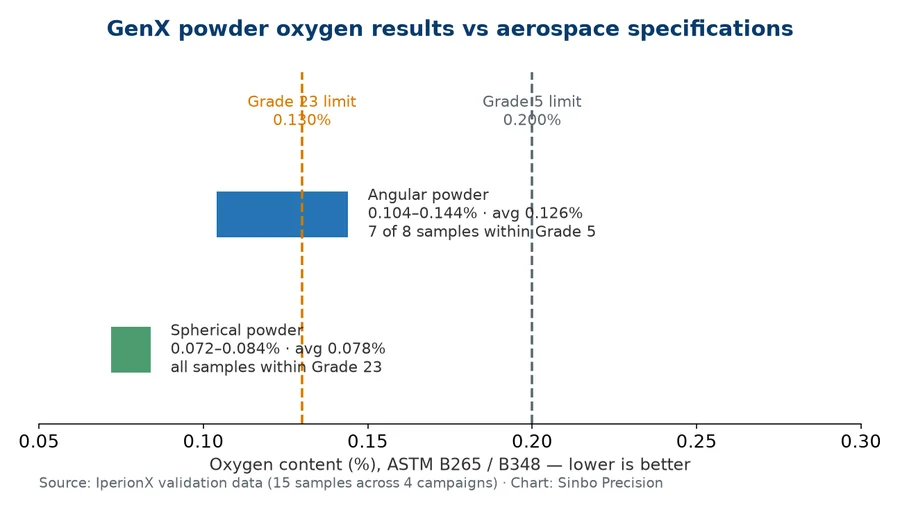
Low cost means nothing if the powder is not specification-grade. The validation measured oxygen across runs. Angular powder came out at 0.104–0.144% oxygen (average 0.126%): 7 of 8 samples met the Grade 5 limit of 0.200% under ASTM B265 and B348, and 4 of 8 met the stricter Grade 23 limit of 0.130%. Spherical powder — the type additive machines eat — came out at 0.072–0.084% (average 0.078%), with all samples meeting Grade 23. In plain terms: the low-cost-route powder is arriving at aerospace-relevant oxygen specs, which is what keeps the door open to structural applications.
What It Does NOT Mean Yet
Validation is not production. The industrial-scale GenX line is still at the technoeconomic and engineering evaluation stage, with that work advancing through Q4 2026. IperionX's current 200 tpa production ramp in Virginia does not depend on GenX. And powder is not bar: most machined titanium parts today are cut from rolled or forged mill product, not powder — powder routes reach parts through additive manufacturing and sintering, which compete with machining on some geometries and complement it on others. None of your quotes will move this quarter because of this announcement.
What to Ask a Titanium Supplier About This
The useful move now is not waiting for cheaper titanium — it is knowing where your supplier sits on the curve when the curve moves. Ask:
- What is the feedstock source? Mineral-derived, scrap-derived, or a mix — scrap-based routes track new-process economics sooner.
- Can you quote oxygen data per heat? A supplier who can show 0.130%-capable material per certificate can follow the spec landscape as it tightens.
- Which grades do you run, and which do you avoid? Grade 5 and Grade 23 behave differently in the same shop, and the gap shows up in finish machining.
- Do you quote powder-based routes for complex geometry? Near-net sintered blanks plus finish machining is where continuous powder production eventually lands on part cost.
The Honest Summary
The titanium industry has run on batch logic for generations; a commercial-scale continuous furnace has now run 500 kg at spec with inputs cut across the board. That is a genuine inflection in the titanium cost curve — and it is an inflection you can see from a distance. Industrial-scale lines, sintered near-net parts, and quotes that reflect any of it are still years out. Buy on today's numbers; watch this curve; and keep a supplier who can tell you which side of it their material comes from.
Frequently Asked Questions
Will machined titanium parts get cheaper because of this?
Not yet, and not directly at first. GenX cuts the cost of titanium powder production — powder feeds additive and sintered near-net parts more than it feeds the rolled bar and plate that machining shops cut. Cheaper powder pulls the whole titanium cost structure down over time as capacity scales, but quotes for cut-from-bar parts move when mill product prices move. Treat this as direction, not a price event.
What is the practical difference between Grade 5 and Grade 23 oxygen limits?
Grade 5 Ti-6Al-4V allows up to 0.200% oxygen; Grade 23 (the ELI variant) caps it at 0.130%. Lower oxygen means better ductility and fracture toughness — which is why Grade 23 is specified for fracture-critical and medical work. GenX angular powder averaged 0.126% and spherical powder came fully within Grade 23, meaning the low-cost route is reaching the tougher spec, not just the commodity one.
Should buyers change sourcing strategy now?
No — but build the option. Keep quoting on current mill material, ask suppliers for feedstock source and per-heat oxygen data, and for complex low-volume titanium geometry, get a parallel quote on a sintered near-net blank with finish machining. When continuous powder capacity actually scales, the suppliers holding those answers will price the transition first.
Sources
- IperionX press release, "IperionX Validates GenX Continuous Titanium Production" (GlobeNewswire, Sept 16, 2026) — 4 campaigns, 41 hours, >500 kg at ~12 kg/h; 6x throughput vs batch HAMR; power -75%, magnesium -45%, hydrogen -60% per kg; angular oxygen 0.104–0.144% (7 of 8 within Grade 5 at 0.200%, 4 of 8 within Grade 23 at 0.130%), spherical 0.072–0.084% all within Grade 23; Q4 2026 technoeconomic work; 200 tpa ramp independent of GenX; US Army Task Order 2 of Aug 31, 2026 under US$99M SBIR Phase III.
- IperionX — company announcements (iperionx.com) — Original company version of the GenX validation announcement.
GenX results are company-reported validation data from IperionX production campaigns. Industrial-scale economics remain subject to engineering evaluation; this article is market information, not investment or procurement advice.
Related Reading
Grade 5 Titanium CNC Machined Parts
Ti-6Al-4V components we machine: capabilities, tolerances and typical applications.
Custom Titanium Machining Services
Grades we run, feeds and speeds we use, and how titanium quotes are built.
US Machine Tool Orders Hit Their Third-Highest Month on Record
The equipment boom on the machining side of the industry — and what it does to your lead times.