5-Axis vs 3-Axis CNC Milling: When Does It Pay Off?
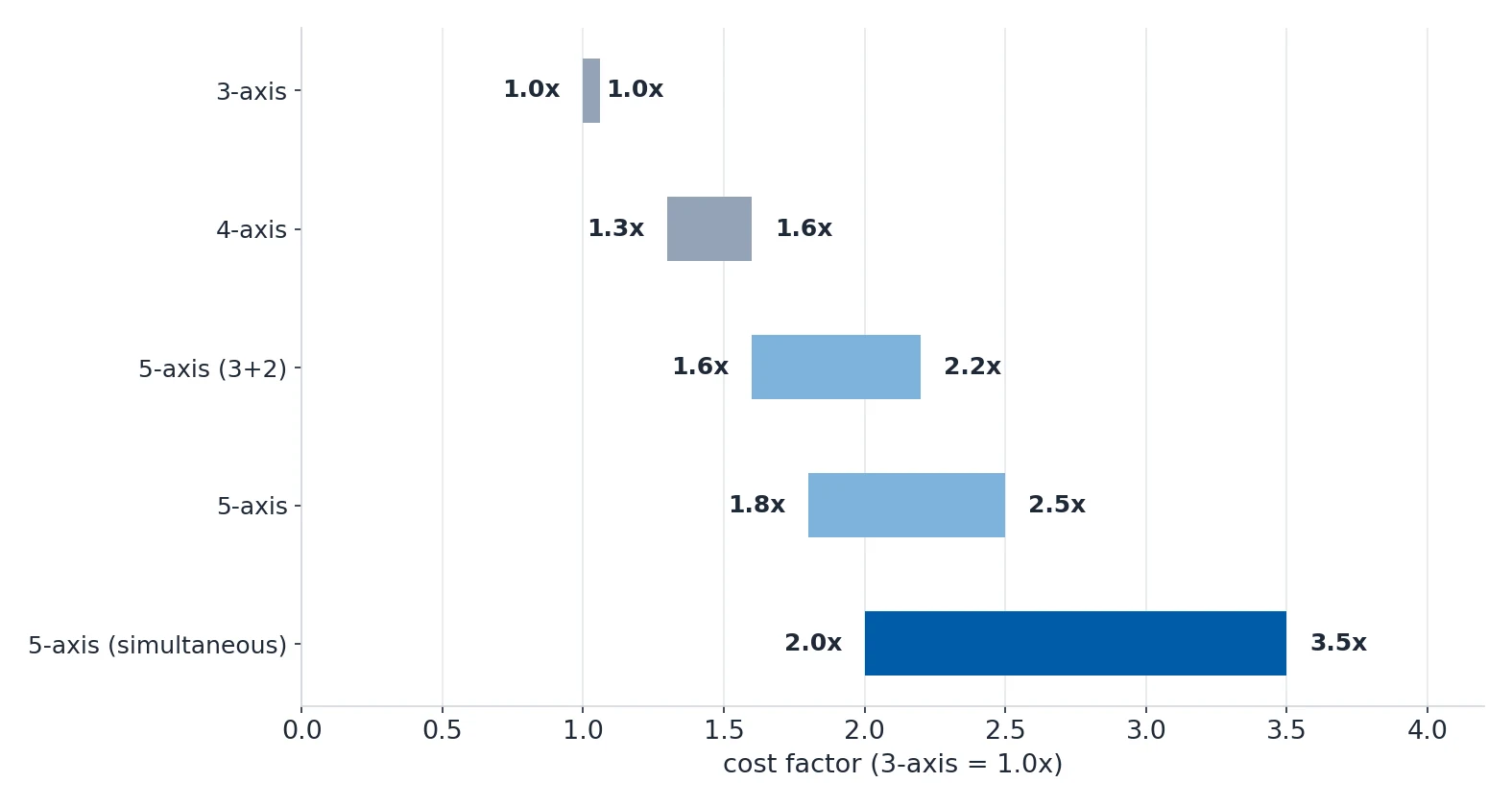
3-axis machines run about 80% of milled parts, and 5-axis only earns its money on a short list of
geometries: contoured surfaces, deep cavities with small corner radii, and features on three or more
sides with tight mutual tolerance. The expensive mistake is not choosing 3-axis when you needed
5-axis. It is writing "5-axis" on a drawing when 3+2 positioning would have done the same job — the
shop prices for simultaneous 5-axis programming and the quote doubles or triples.
Which Machine Your Part Actually Needs
| What Your Part Needs | Use This | Why | Cost Factor |
|---|---|---|---|
| Flat features, pockets, holes, 2D profiles — all accessible from one direction | 3-axis | 80% of milled parts. Fast setup, wide machine availability, lowest hourly rate. | 1.0x (baseline) |
| Features on 2 sides, with tight positional tolerance between them | 4-axis | Rotary A-axis lets you machine the second side without unclamping. Eliminates setup error. | 1.3–1.6x |
| Holes or slots at compound angles (not 0/90 degrees) | 4-axis or 3+2 | Index the part to the correct angle, then mill/drill in 3 linear axes. No simultaneous rotation needed. | 1.3–1.6x |
| Complex contoured surfaces (impellers, turbine blades, molds) | Simultaneous 5-axis | Tool stays normal to the surface throughout the cut. Better finish, shorter cycle time, fewer setups. | 2.0–3.5x |
| Features on 3+ sides with tight mutual tolerance | 3+2 positioning on a 5-axis machine | 5-axis machine used in indexed mode. Cheaper than simultaneous 5-axis programming and machining. | 1.6–2.2x |
| Deep pockets with small corner radii that need short, rigid tools | 5-axis | Tilt the head to reach with a shorter tool. Less deflection, better finish, faster material removal. | 1.8–2.5x |
Read the last row carefully. A deep pocket with a small corner radius can be machined on a 5-axis
machine for 1.8–2.5x, but it can often be machined on a 3-axis machine for 1.0x if you redesign the
pocket — that is a design decision, not a machining decision, and it is worth more than any argument
with the shop about machine rates.

What Each Configuration Actually Delivers
| Parameter | 3-Axis | 4-Axis | 5-Axis (3+2) | 5-Axis (Simultaneous) |
|---|---|---|---|---|
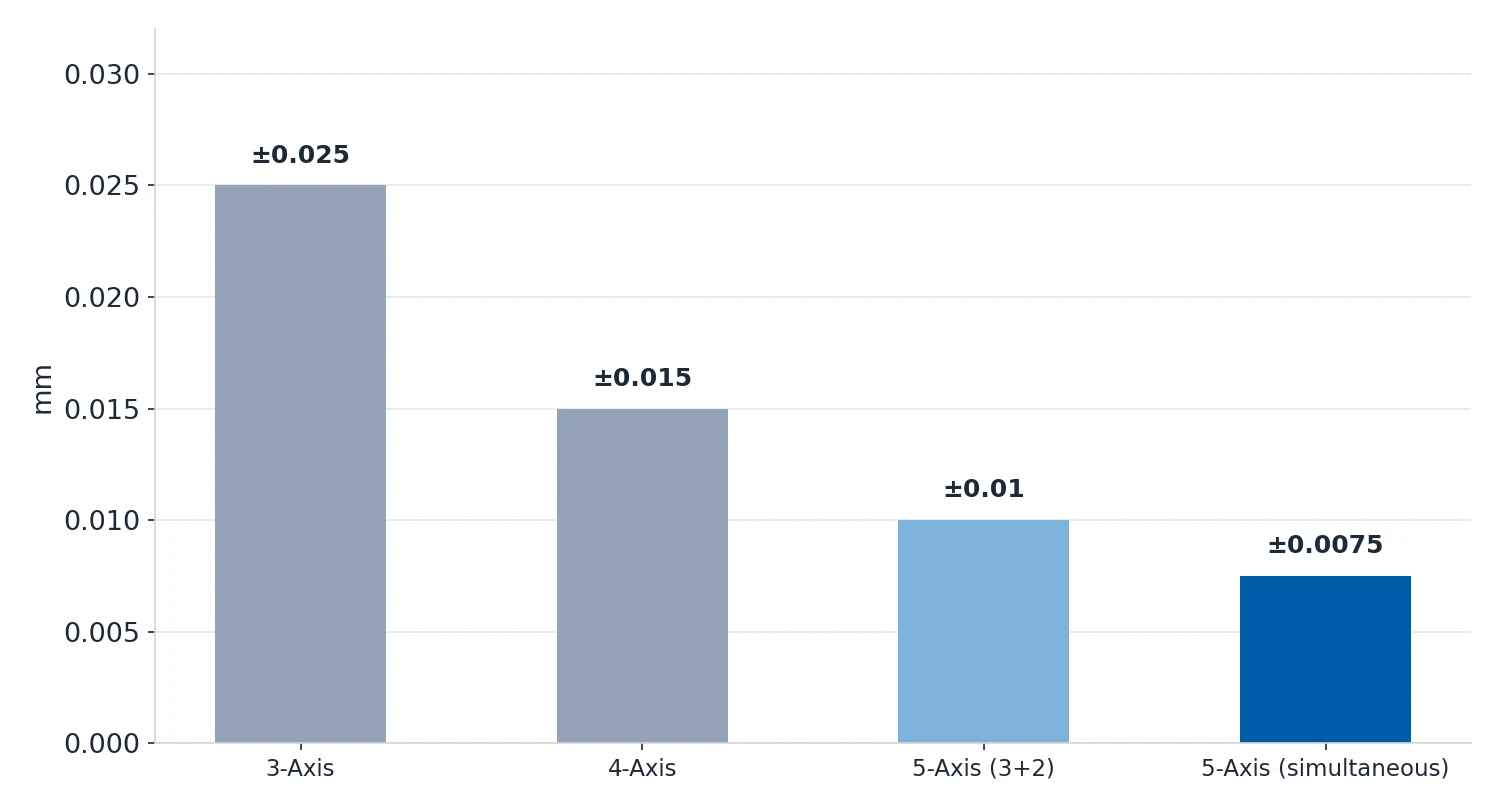
| Typical accuracy | ±0.025 mm | ±0.015 mm | ±0.01 mm | ±0.005–0.01 mm |
| Surface finish (Ra) | 1.6–3.2 µm | 0.8–1.6 µm | 0.8–1.6 µm | 0.4–1.6 µm |
| Max part size | Up to 2000mm | Up to 1000mm dia. | Up to 800mm | Up to 600mm |
| Setup cost factor | 1.0x | 1.2x | 1.5x | 2.0–3.0x |
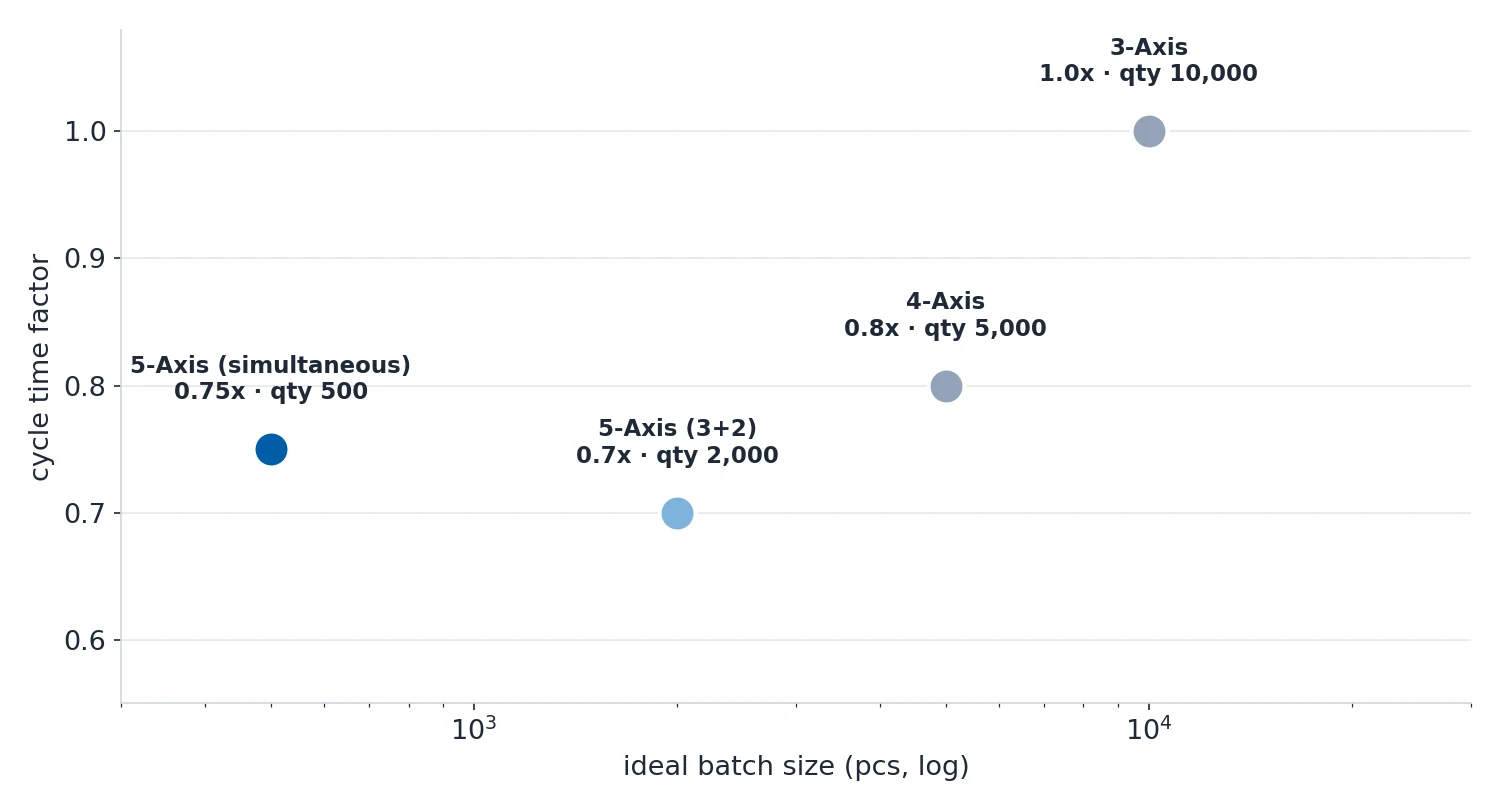
| Cycle time factor | 1.0x | 0.8x (fewer setups) | 0.7x (fewer setups) | 0.6–0.9x |
| Ideal batch size | 1–10,000+ | 5–5,000 | 1–2,000 | 1–500 |
| Undercuts | No | Limited | Yes | Yes |
| Multi-side features | Flip required | Single setup | Single setup | Single setup |
Three facts in this table decide most cases. Accuracy: going from 3-axis to simultaneous 5-axis
buys you about ±0.02 mm, and most drawings never needed it. Cycle time: every step up reduces the
cycle time factor, because setups disappear — 0.6–0.9x for simultaneous 5-axis against 1.0x for 3-axis, which
is a saving that only matters if the setup count was the problem. Batch size: the ideal batch for
simultaneous 5-axis is 1–500, against 1–10,000+ for 3-axis, because the programming and setup cost
has to be amortized over the run.
3+2 or Simultaneous: Which One
The distinction is not technical, it is commercial. If you can list the machining angles as fixed
values, you need 3+2.

| Feature Type | Example | Why 3+2 Works |
|---|---|---|
| Angled holes | Mounting holes at 15°, 30°, 45° | Tilt to angle, drill straight. No continuous rotation needed. |
| Multi-side flats | Hexagonal or square profiles | Index 60° or 90°, mill each face. |
| Pockets on angled surfaces | Mounting pads on a contoured surface | Tilt so pocket floor is horizontal, then 3-axis pocket it. |
| Back-side features | O-ring grooves, threaded holes on the bottom | Flip 180° in the same clamping. No re-fixturing. |
| Radial features on cylindrical parts | Cross-holes, keyways, flats on a shaft | Rotate to position, then cut in X-Y plane. |
| Feature Type | Example | Why Simultaneous Is Required |
|---|---|---|
| Complex contoured surfaces | Impellers, turbine blades, propellers | Tool angle must change continuously to follow the surface curvature. |
| Deep-cavity mold cores | Injection mold cores with tall ribs | Tilt the tool to avoid collision with cavity walls while maintaining reach. |
| Aerospace structural parts | Spar caps, wing ribs with thin walls | Single-setup machining eliminates tolerance stack-up on critical datums. |
| Medical implants | Joint replacements, bone plates | Complex organic surfaces with tight tolerances and demanding surface finish. |
The four rows in the second table have one thing in common: the tool angle has to change while it is
cutting, or the part must be held in one setup for tolerance reasons. If neither applies, you are
paying the simultaneous 5-axis price for an indexed operation.

What 5-Axis Changes About the Part You Design
Machine choice and part design are the same conversation. These are the design rules that come out of
the machine table.

| DFM Rule | Guideline | Why It Matters |
|---|---|---|
| Avoid deep pockets | Keep depth-to-width ratio ≤ 4:1 | Long tools deflect. A 10mm end mill extending 60mm into a pocket vibrates, leaves a poor finish, and takes forever. If you need depth, use stepped pockets with intermediate diameters. |
| Internal corner radii | Specify R1.5, R3, R6mm (standard end mill sizes) | End mills are round — they can't cut a sharp 90° internal corner. If you specify R0.5mm, the shop has to use a tiny tool (slow, fragile) or wire EDM (expensive). Match your fillet radii to available tool sizes. |
| Floor radii | Min R3mm, prefer R6mm | Ball nose end mills have a radius. A flat pocket floor with sharp corners to the walls is impossible with standard tooling. The larger the floor radius, the larger (faster, cheaper) the tool you can use. |
| Wall thickness | Min 0.8mm (aluminum), 1.0mm (steel), 1.5mm (titanium) | Thinner walls deflect under cutting forces, causing chatter, poor finish, and dimensional inaccuracy. Titanium walls under 1.5mm are nearly impossible to mill cleanly. |
| Minimize setups | Design features accessible from as few directions as possible | Every flip means: unclamp, clean, re-clamp, re-establish datum, re-zero. Each setup adds $30–100 in labor plus tolerance stack-up. |
| Boss height | ≤ 4x base diameter | Tall, thin bosses deflect during machining. If you need height, add gussets or increase the base diameter. |
| Thread depth | Max 1.5–2x diameter for blind holes | Threads beyond 2x diameter don't add meaningful strength — the load is carried by the first few threads. Deep threads require long taps that break easily and are slow to cut. |
| Standard hole sizes | Use standard drill and reamer sizes | Non-standard holes require custom tooling or boring operations. Both add cost and lead time. When possible, match to standard drill charts. |
| Engraving text/logos | Min stroke width 0.3mm, min depth 0.2mm | Smaller engraving is unreadable after anodizing or painting. Keep it functional or use laser marking post-machining. |
Two rules do more for the quote than any machine discussion. Corner radii matched to standard end
mill sizes lets the shop use a 6mm cutter instead of a 2mm cutter, which is faster and stiffer.
Minimum wall thickness at 0.8mm for aluminum, 1.0mm for steel and 1.5mm for titanium is where
chatter and dimensional error start, and no amount of machine capability fixes a wall that is too thin.

Where the Money Actually Goes
| Cost Driver | Impact | How to Reduce It |
|---|---|---|
| Number of setups | High — each setup adds $30–100+ in labor and fixturing | Design for single-setup machining where possible. Use 4-axis or 3+2 to eliminate flips. |
| Tight tolerances | High — ±0.01mm costs 2–4x more than ±0.05mm | Apply tight tolerances only where functionally necessary. Loosen non-critical dims. |
| Surface finish requirements | Medium-High — Ra 0.4 requires extra passes, slower feeds, sometimes grinding | Only specify fine finish on visible or sealing surfaces. Ra 1.6 is adequate for most non-cosmetic parts. |
| Material hardness | Medium — harder materials mean slower cuts, faster tool wear, more tool changes | Use the softest material that meets your strength requirements. Consider pre-hardened vs. through-hardened. |
| Material cost | Medium — titanium is 5–8x the price of aluminum per kg | Optimize stock size to minimize waste. Consider near-net-shape casting or forging for expensive materials. |
| Complex geometry | Medium — 5-axis programming, longer cycle times, more setups | Simplify where possible. Can that curved surface be a flat with drafted sides? |
| Custom tooling | Low-Medium — special cutters, form tools, custom fixtures | Design around standard tool sizes. Use standard thread sizes, standard drill sizes. |
| Inspection requirements | Low-Medium — CMM inspection, third-party certs, material traceability | Only specify CMM on critical dims. Full CMM reports on every part add $20–50 each. |
| Quantity | Variable — setup amortization changes everything | Setup cost is fixed; per-part cost drops with quantity. At qty 100+, fixturing and process optimization start to pay off. |
Notice that the machine itself is not on this list. A buyer who thinks the quote is set by "3-axis vs
5-axis" is looking at the wrong column — the quote is set by setups, tolerances and material, and the
axis count only moves those three indirectly.
The Mistakes That Inflate a 5-Axis Quote
| Mistake | Consequence | Fix |
|---|---|---|
| Specifying "5-axis" when 3+2 is sufficient | Quote doubles or triples because the shop assumes simultaneous 5-axis programming | Specify "3+2 positioning on 5-axis machine" if that's all you need. Or just say "multi-side machining, single setup." |
| R1mm internal fillets everywhere | Forces small finishing tools, slow cycle time, poor finish, frequent tool changes | Use R3mm or larger wherever possible. Only use small radii where geometry demands it. |
| Deep pockets (depth > 4x width) | Tool deflection, chatter, poor finish, broken tools, long cycle times | Step the pocket with intermediate diameters. Or redesign to reduce depth. |
| Tight tolerance on non-critical features | Entire part priced at precision rates. Every dimension inspected to tight spec. | Use GD&T. Apply ±0.01mm only to datums and mating surfaces. Leave everything else at ±0.05–0.1mm. |
| Sharp internal corners (R0) | Impossible to machine with standard tools. Requires EDM, adding $100–500 and days of lead time. | Always add a fillet radius. Minimum R0.5mm, prefer R1.5–R3mm. |
| Thread depth beyond 2x diameter | Weak threads (only first few threads carry load), broken taps, long tapping cycles | Limit blind hole thread depth to 1.5–2x diameter. Add a thread relief if needed. |
| Specifying Ra 0.4 everywhere | Multiple finishing passes, slower feeds, possible grinding operation — massive cost increase | Ra 1.6 for non-cosmetic surfaces. Ra 0.8 for mating surfaces. Ra 0.4 only for seals or visible cosmetics. |
| Not accounting for anodize thickness | Part goes oversize after Type II anodize (+10–25µm per surface) and doesn't fit in the assembly | Machine undersize by half the expected coating thickness before anodizing. |
| Using HSS tooling for production | Low initial tool cost but 5–10x more tool changes, slower cutting speeds, higher cost per part | Use carbide for any batch over 10 pcs. The per-part tooling cost is lower despite the higher purchase price. |
| Forgetting about workholding access | Shop has to build a custom fixture ($200–2000) because the part geometry has no clamping surfaces | Add flats, bosses, or holes for clamping. Or at minimum, discuss fixturing with the shop before finalizing the design. |
The one-sentence version to put on your drawing
If you can index the part and still hold the tolerance, say "3+2 positioning on a 5-axis machine".
If the tool angle has to change while it cuts, say "simultaneous 5-axis". If everything is
reachable from one direction, say "3-axis" and save the difference for the tolerances that
actually matter.