Titanium vs Aluminum for Aerospace and Medical Parts: How to Choose
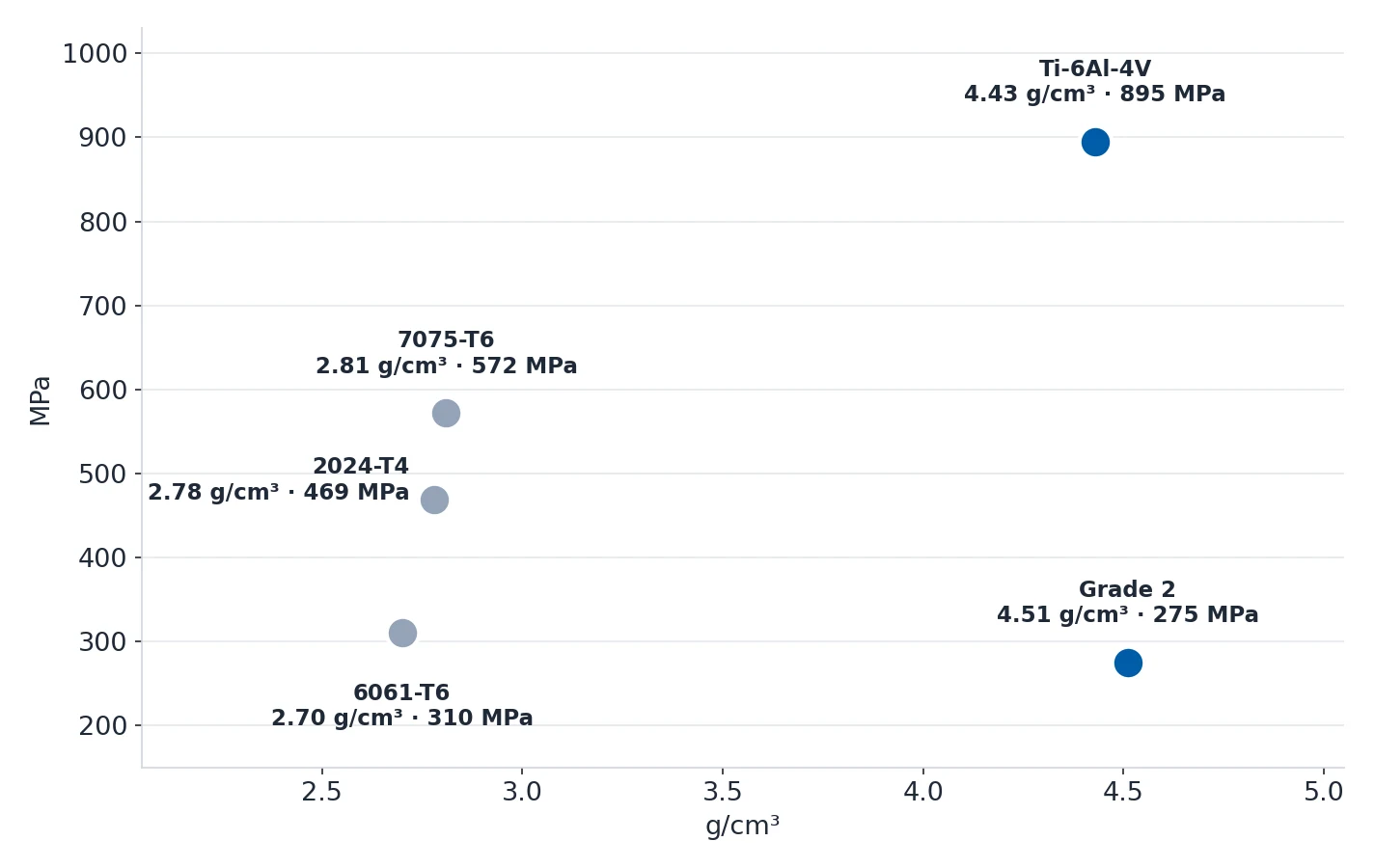
Ti-6Al-4V is 4.43 g/cm³ and gives 895–930 MPa tensile; 6061-T6 is 2.70 g/cm³ and gives 310 MPa.
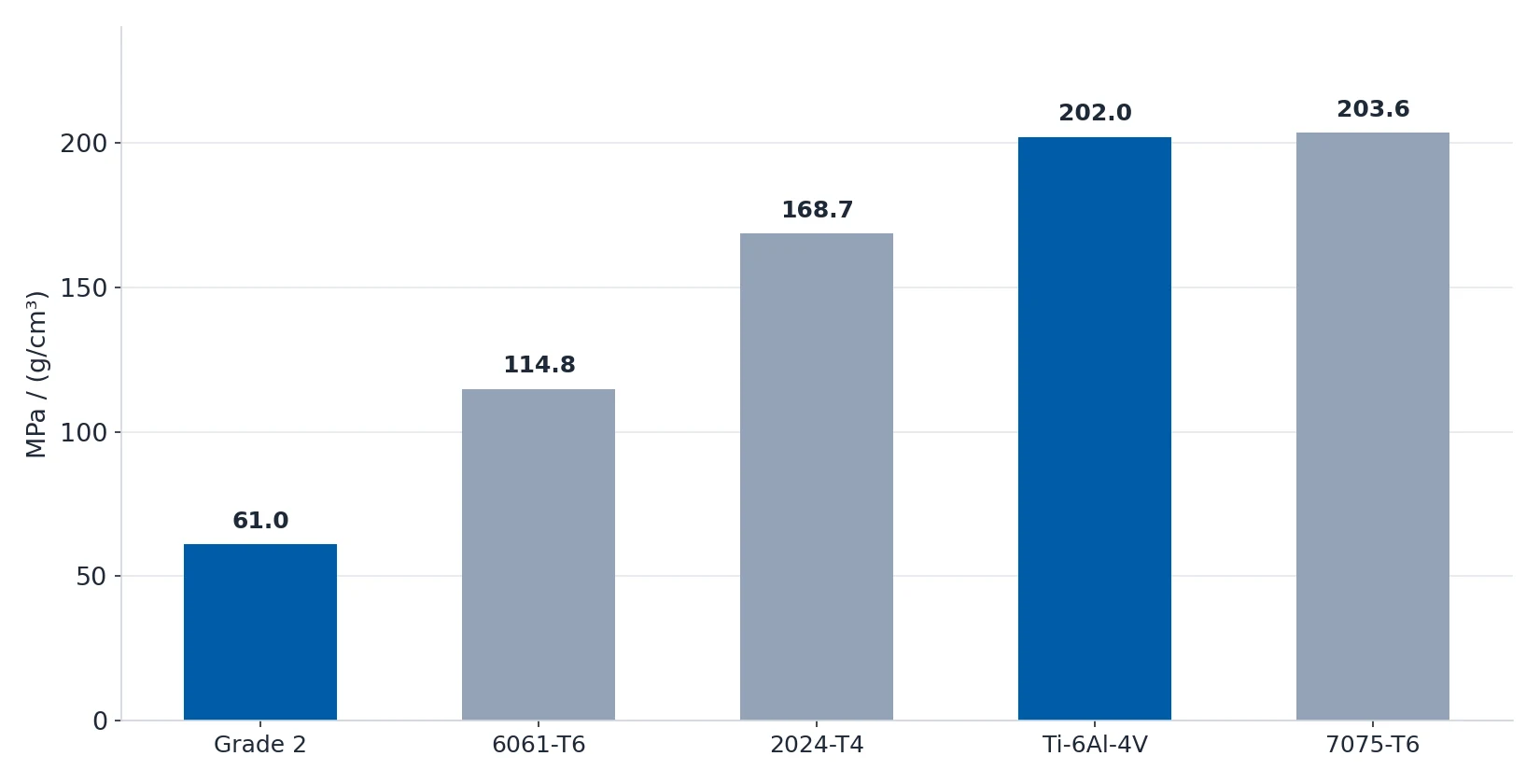
Divide by density and the ranking changes: Ti-6Al-4V reaches 202.0–209.9 MPa per g/cm³, 7075-T6
reaches 203.6, and 6061-T6 reaches 114.8. That is the whole decision in one line — 7075-T6 aluminum
carries the same load per unit of weight as Ti-6Al-4V, at 40% of the titanium material cost. So the
question is never "which material is stronger". It is "does this part need titanium's strength and
its corrosion or biocompatibility behaviour, or only its strength?"
Where Titanium Is Actually the Right Choice
Start from the duty, not from the material list. Titanium earns its place when the service environment
does the arguing for it.
| Your Situation | Use Titanium? | Better Alternative |
|---|---|---|
| Aerospace / airframe structural | Yes | — |
| Medical implants (biocompatibility) | Yes | — |
| Marine (saltwater, no heat) | Maybe | 316L stainless is cheaper for non-load parts |
| Chemical processing (corrosive) | Maybe | Hastelloy or super duplex may be better |
| High strength-to-weight (non-aero) | Maybe | 7075-T6 aluminum is cheaper if non-corrosive |
| Just need lightweight + strong | No | 7075 aluminum (same strength, 40% the cost) |
| Just need corrosion resistance | No | 316 stainless (5–10x cheaper) |
| Prototype / low volume | No | Prototype in aluminum or steel first |
Two "Yes" rows, three "Maybe" rows and three "No" rows. A buyer who lands on titanium has to clear one
of the two "Yes" rows, or argue a "Maybe" row on engineering grounds. Everything else is paying the
premium for a property the part does not use.

Strength, Density and Specific Strength
| Property | 6061-T6 | 7075-T6 | 2024-T4 | Grade 2 (CP) | Ti-6Al-4V |
|---|---|---|---|---|---|
| Tensile (MPa) | 310 | 572 | 469 | 275–410 | 895–930 |
| Yield (MPa) | 275 | 503 | 324 | 170–275 | 825–860 |
| Density (g/cm³) | 2.70 | 2.81 | 2.78 | 4.51 | 4.43 |
| Elongation | 12% | 11% | 20% | — | — |
| Hardness | 95 HB | 150 HB | 120 HB | 200–275 HB | 33–36 HRC |
| Machinability | Excellent | Good | Fair | Better | Hard on tools |
| Weldable | Yes | No | No | Yes | Difficult (requires protection) |
| Relative cost | 1.0x | 1.8–2.5x | 1.5–2.0x | 1.0x | 1.3–1.5x |
Read the hardness row carefully: Grade 2 at 200–275 HB and Ti-6Al-4V at 33–36 HRC are not on the same
scale, so do not compare them directly. What matters is the contrast with aluminum — 6061-T6 at 95 HB
and 7075-T6 at 150 HB are the two most machinable options on the table, and that difference is where
most of the cost of titanium comes from.
The specific strength column is the one that settles most arguments:
| Material | Tensile (MPa) | Density (g/cm³) | Specific tensile (MPa per g/cm³) |
|---|---|---|---|
| 6061-T6 | 310 | 2.70 | 114.8 |
| 7075-T6 | 572 | 2.81 | 203.6 |
| 2024-T4 | 469 | 2.78 | 168.7 |
| Grade 2 (CP) | 275 | 4.51 | 61.0 |
| Ti-6Al-4V | 895 | 4.43 | 202.0 |
7075-T6 and Ti-6Al-4V land within 1% of each other per unit of weight. 2024-T4 is the aluminum choice
when fatigue endurance matters — 20% elongation and 469 MPa — and it is the grade used in aircraft
skins and wing structures, which is why it appears in aerospace drawings next to titanium. Grade 2 at
61.0 is nowhere near either of them; its case is corrosion and biocompatibility, not strength.
Grade 2 or Ti-6Al-4V
| Property | Grade 2 (CP) | Ti-6Al-4V (Grade 5) |
|---|---|---|
| Type | Commercially pure | Alpha-beta alloy |
| Tensile (MPa) | 275–410 | 895–930 |
| Yield (MPa) | 170–275 | 825–860 |
| Density (g/cm³) | 4.51 | 4.43 |
| Hardness | 200–275 HB | 33–36 HRC |
| Weldable | Yes | Difficult (requires protection) |
| Heat treatable | No | Yes (aging increases strength) |
| Machinability | Better | Hard on tools |
| Relative cost | 1.0x | 1.3–1.5x |
| Use for | Chemical, marine, biomedical | Aerospace, high-strength |
The rule is short: corrosion resistance without high strength means Grade 2; high strength at low
weight means Ti-6Al-4V. One trap worth naming — Grade 2 yield reaches only 275 MPa, which is weaker
than 6061-T6. Specifying Grade 2 for a highly loaded structural part is a downgrade, not an upgrade.

What Titanium Changes on the Machine
Titanium is not an expensive material that you machine like aluminum. It is a different process with
different rules, and the rules are what drive the cost.
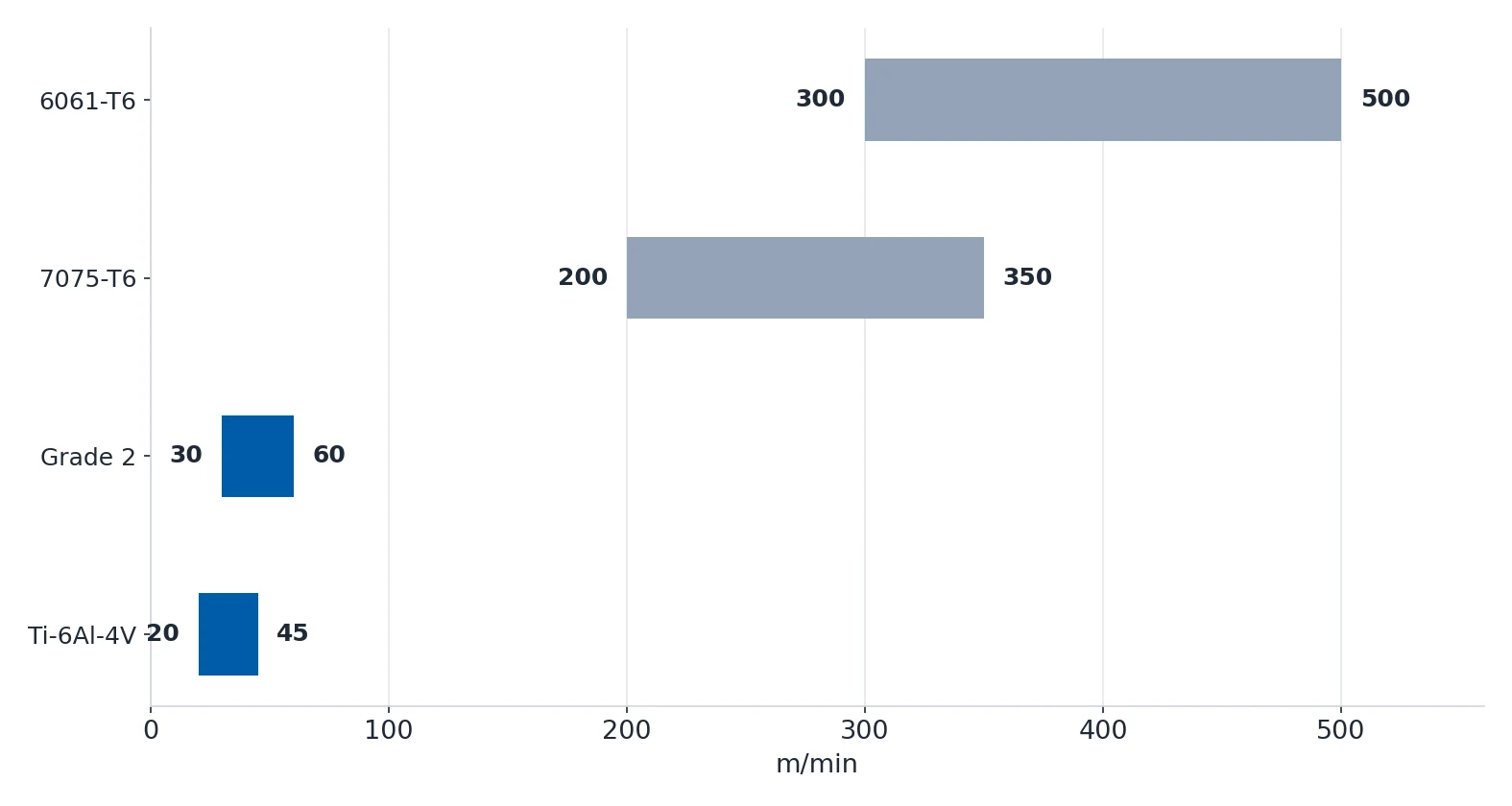
| Material | Roughing (m/min) | Finishing (m/min) | Tooling note |
|---|---|---|---|
| 6061-T6 | 300–500 | 500–800 | Aggressive, 6061 cuts easy |
| 7075-T6 | 200–350 | 350–550 | 20–30% slower than 6061 |
| Grade 2 titanium | 30–60 | — | Positive rake, sharp edge |
| Ti-6Al-4V | 20–45 | — | TiAlN or diamond coating, 3–5x longer life |
Four rules decide whether a titanium part succeeds or becomes scrap:
- Low cutting speed. Grade 2 runs 30–60 m/min and Ti-6Al-4V runs 20–45 m/min. Going faster only
burns the tool without cutting faster. - Flood coolant is mandatory. Titanium has poor thermal conductivity, so heat stays at the cutting
edge. Without flood coolant, tool life drops to minutes. - Replace tools on first sign of wear. Titanium work-hardens. A dull tool leaves a hardened surface
layer that kills the next tool as well. TiAlN or diamond-coated end mills last 3–5x longer. - Thin chips, multiple shallow passes. Keep the radial depth of cut small, because thick chips
generate too much heat.
And one safety rule that has no equivalent in aluminum: never use cutting oil. Fine titanium chips
can ignite, and a titanium fire burns at 3000°C+ — it cannot be extinguished with water because it
burns hotter. Use water-based flood coolant and keep the machine clean of chips.

Surface Finishes: What Works on Which
| Treatment | Titanium | Aluminum |
|---|---|---|
| Anodize (Type II) | Blue, purple and gold colours; popular for medical and aerospace | 6061 gives the most consistent colour; 7075 comes out dark and uneven |
| Hard anodize (Type III) | — | 7075 hard coat is less wear-resistant |
| Grit blasting | Matte finish, required before many coating processes | Surface preparation |
| Polishing | Polishes well but is labour-intensive | Electropolish possible, but not common |
| PVD coating | TiN and CrN for reduced friction; used in medical implants | — |
Two practical notes. First, anodizing adds 10–25 µm per surface, so on a tight feature the part goes
oversize after coating — machine undersize by half the anodize thickness before it goes out. Second,
titanium anodizing is a different electrochemistry from aluminum anodizing even when both are called
Type II; a supplier who has only run aluminum lines is not automatically qualified for a titanium
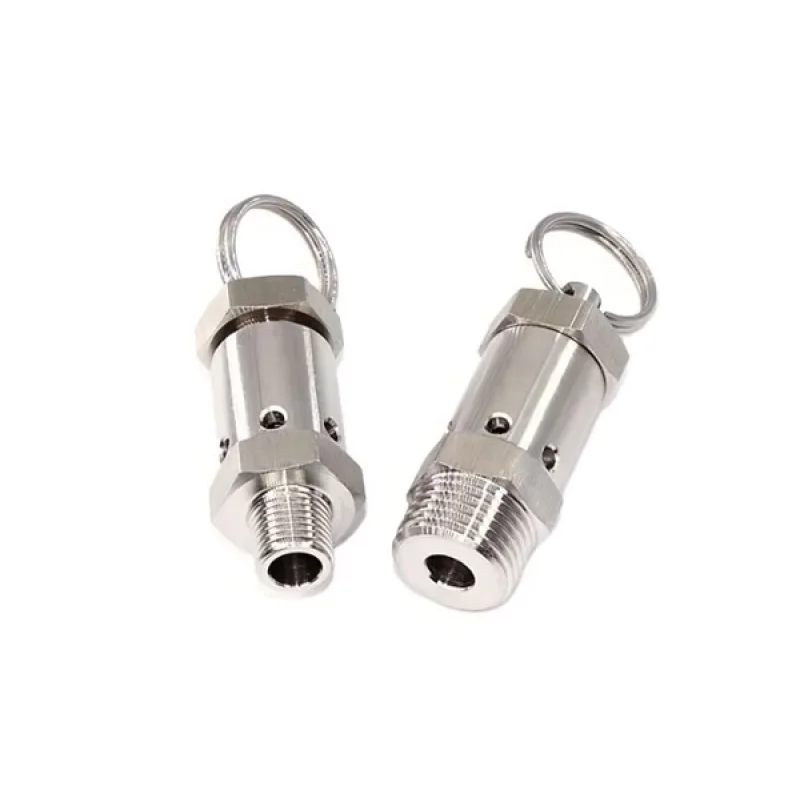
finish.
Where Buyers Over-Specify Titanium, and What It Costs
| Mistake | What happens | Correct approach |
|---|---|---|
| Specifying titanium when aluminum suffices | Paying 5–10x material cost for no benefit | Do the strength/weight/corrosion calculation. Most parts do not need titanium. |
| High cutting speed | Tool burns out in minutes, poor surface finish | Keep below 60 m/min for Grade 2, 45 m/min for Ti-6Al-4V |
| Using cutting oil | Fire risk with titanium chips | Water-based coolant only |
| Not changing tools frequently enough | Work-hardened surface kills subsequent tools | Replace at first sign of wear |
| Grade 2 for high-strength parts | Yield only 275 MPa — weaker than 6061-T6 | High strength requires Ti-6Al-4V |

The cost stack behind the first row is worth spelling out, because it is what a buyer actually pays:
titanium raw material costs 5–10x more than aluminum and 3–5x more than stainless, machining costs
2–3x more than steel, and a prototype belongs in aluminum or steel first.
What to put on the drawing
- The grade and the condition together —
Ti-6Al-4VorGrade 2, and whether it is annealed,
solution treated or aged. "Titanium" alone leaves the strength open. - The environment — saltwater, body contact, chemical spray. If none of these apply, say so on the
drawing; it is the fastest way to justify an aluminum alternative. - The load and its direction — if the part is not loaded past 503 MPa, 7075-T6 aluminum covers it.
- The finish — Type II anodize, PVD or bare, fixed before the part is quoted, because anodizing
changes the dimensions. - The prototype path — if the part is still in development, machine the first article in 6061-T6
and switch to titanium only once the design is frozen.