How to Reduce CNC Machining Costs Without Changing the Design
The cheapest cost reduction is not a design change at all: it is ordering the right quantity and giving the shop the right stock size. Setup is a fixed cost and material is bought by the kilogram or by the bar, so those two levers move the unit price without touching a single feature on the drawing. The design changes that do pay are mostly small — loosening a tolerance nobody needed, opening a pocket to the edge, using one fillet radius instead of three — and they change the drawing without changing the function.
Where the Money Actually Goes
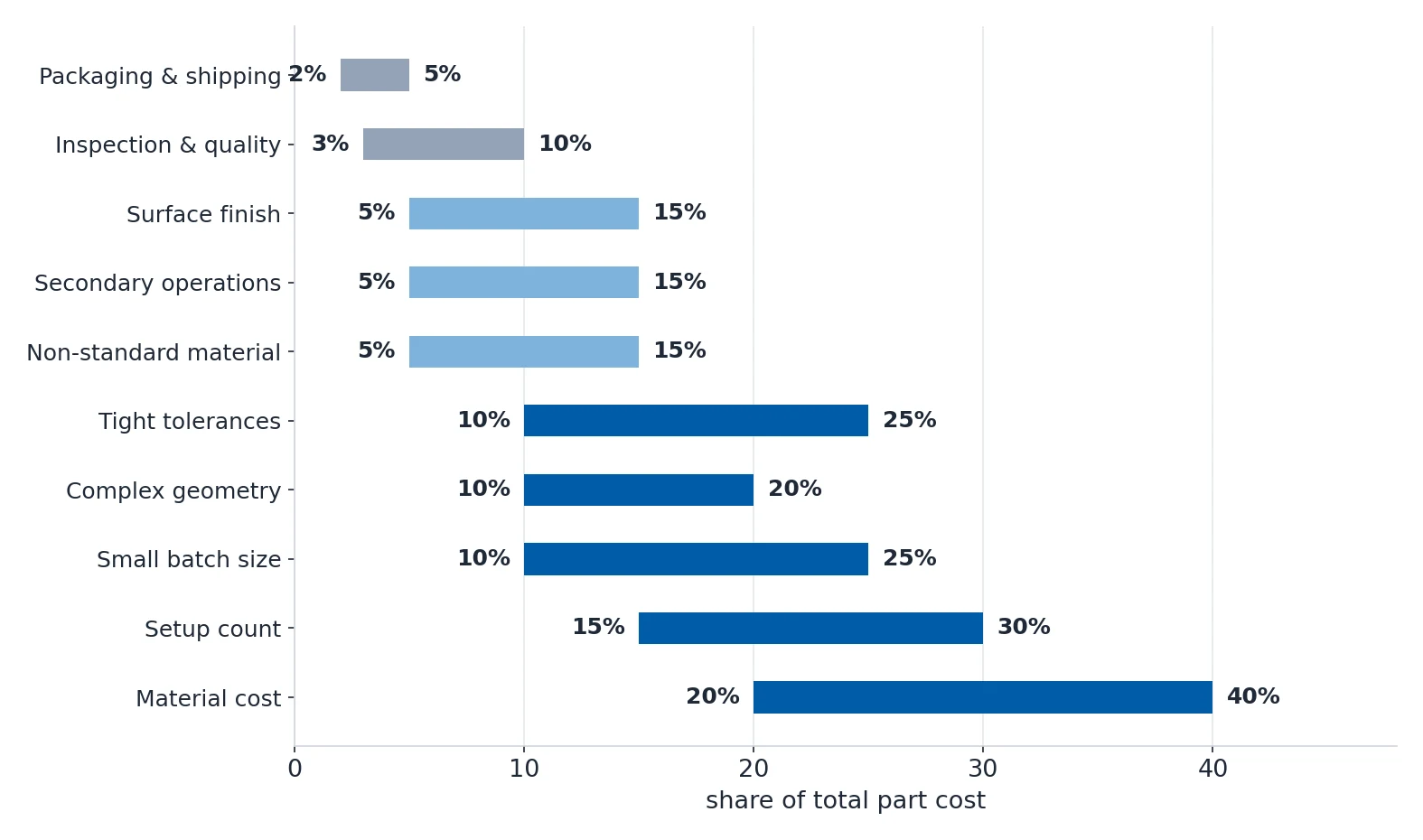
A CNC quote is not one number, and understanding the line items is what lets you move them.
| Rank | Cost driver | Typical cost share | Cost range impact | Key insight |
|---|---|---|---|---|
| 1 | Setup count | 15–30% | +50–200% | Every setup, flip, re-fixture or machine change adds $30–80 in labour and lost spindle time. This is the single biggest controllable driver. |
| 2 | Material cost | 20–40% | +40–500% | Raw material is often the largest line item. Titanium costs 8–12× aluminum, and non-standard sizes force buying full bars with 60–80% scrap. |
| 3 | Tight tolerances | 10–25% | +30–150% | Moving from ISO 2768-mK at ±0.1 mm to ±0.01 mm adds finishing passes, inspection and scrap risk. Every extra decimal costs exponentially more. |
| 4 | Surface finish requirements | 5–15% | +20–100% | Ra 3.2 is standard. Ra 1.6 adds a finish pass. Ra 0.4 requires grinding or polishing, a completely different process and cost level. |
| 5 | Complex geometry | 10–20% | +30–120% | 5-axis contoured surfaces, deep pockets, undercuts and compound angles all need specialized tooling, slower feeds and longer programming time. |
| 6 | Small batch size | 10–25% | +40–300% | Setup cost per part drops sharply with quantity. A $500 setup spread over 5 parts adds $100 per part; spread over 500 parts, it adds $1. |
| 7 | Non-standard material | 5–15% | +15–80% | Exotic alloys such as Inconel or Hastelloy cost more to buy, more to machine and more to source. Standard materials are always cheaper. |
| 8 | Secondary operations | 5–15% | +20–60% | Each additional process, such as anodizing, heat treat, plating or grinding, is a separate setup with its own cost. |
| 9 | Inspection and quality | 3–10% | +10–40% | CMM inspection, first-article inspection, PPAP documentation and material certificates all add cost. |
| 10 | Packaging and shipping | 2–5% | +5–15% | Custom packaging, individual boxing, corrosion protection and express shipping add up. Standard bulk packaging is always cheapest. |
The Lever That Needs No Design Change: Quantity and Stock Size
Setup is a fixed cost; material and cutting time are not. That single fact explains most of the spread between two quotes for the same drawing.
| Quantity | Setup cost per part | Machining and material per part | Total per part | Relative to the 1,000-piece price |
|---|---|---|---|---|
| 1–5 | $100–500 | $30–80 | $130–580 | 3–12× |
| 10–50 | $10–50 | $30–80 | $40–130 | 1.5–3× |
| 100–500 | $1–5 | $25–70 | $26–75 | 1.0–1.5× |
| 500–1,000 | $0.50–2 | $22–65 | $22–67 | 1.0–1.2× |
| 1,000–5,000 | $0.10–0.50 | $20–60 | $20–60 | 0.9–1.0×, the baseline |
| 10,000+ | under $0.10 | $18–55 | $18–55 | 0.8–0.9× |
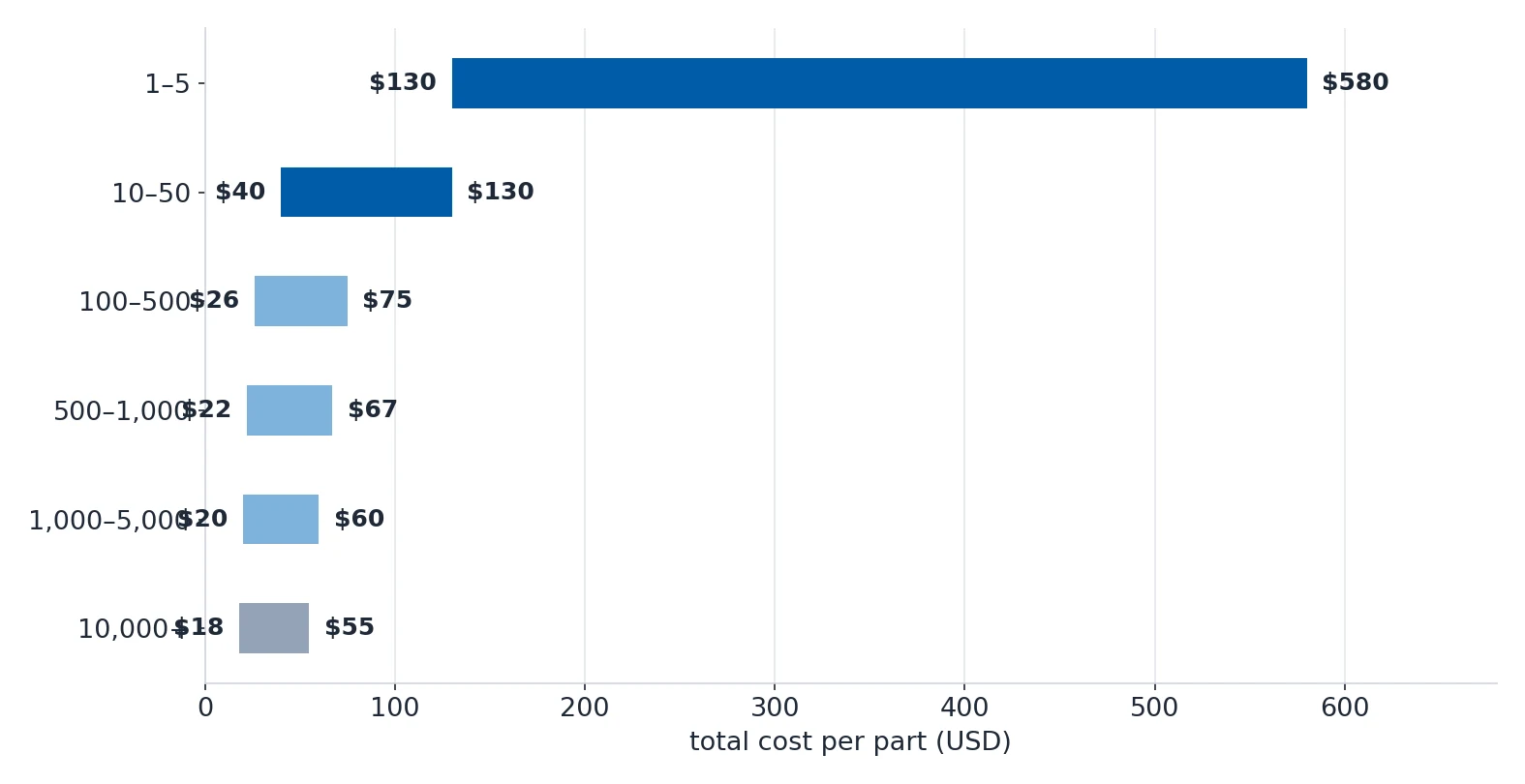
Ordering 5 pieces at a time instead of 50 costs +40–80% per piece, and that is pure waste: the setup runs either way.
The second lever costs nothing at all. Design each part to fit inside a standard bar or plate size. A φ52 mm part cut from φ60 mm bar wastes 8 mm of aluminium per part; a 14 mm thick part cut from 20 mm plate wastes 6 mm of thickness for no reason.
| Stock form | Common sizes | Design tip |
|---|---|---|
| Round bar | φ6, 8, 10, 12, 16, 20, 25, 30, 35, 40, 50, 60, 80, 100 | Design turned parts to fit within standard bar diameters. A φ52 mm part forces buying φ60 bar, 25% more material than needed. |
| Flat bar and plate | Thickness 6, 8, 10, 12, 15, 20, 25, 30, 40, 50; width 100, 150, 200, 250, 300, 400, 500 | Set part thickness to match plate thickness. A 14 mm part cut from 15 mm plate wastes only 1 mm; cut from 20 mm plate it wastes 6 mm. |
| Hex bar | AF 8, 10, 12, 14, 17, 19, 22, 24, 27, 30, 32, 36, 41, 46, 50 | For hex head bolts and nuts, use hex bar stock. It eliminates milling the hex profile and saves 30–50% on those features. |
| Tube and pipe | φ25×3, φ32×3, φ38×4, φ50×5 | Hollow cylindrical parts should start as tube, not solid bar. A φ50×5 tube wastes 64% less material than a φ50 solid bar for a hollow shaft. |
Removing Requirements Nobody Asked For
This is where most of the money is hiding, and none of it changes the function of the part.
| Mistake | Cost impact | Correct approach |
|---|---|---|
| Over-tolerancing everything | +50–150% | Apply tight tolerances only to critical mating surfaces, and use general tolerance per ISO 2768 for everything else. |
| Specifying Ra 0.8 or better just in case | +30–100% | Match the finish to the function. Ra 3.2 is fine for most non-sealing, non-bearing surfaces. |
| Designing features on all 6 faces | +80–200% | Every machined face is a potential setup. Orient the design so all features are reachable from 2–3 sides at most. |
| Specifying titanium or Inconel without justification | +100–500% | These cost 5–10× more to buy and 3–5× more to machine than aluminum or steel. |
| Calling out R0.1 internal corners on a structural bracket | +50–200% | Sharp internal corners are a CNC impossibility and a stress concentrator. Use standard fillet radii of R1, R2 or R3, and the part is both cheaper and stronger. |
| Using non-standard thread sizes | +10–25% | Non-standard taps need a special tool purchase of $20–80 and are not stocked. Use M3, M4, M5, M6, M8, M10, 1/4-20, 5/16-18 or 3/8-16. |
| Specifying full inspection on every dimension | +15–40% | Full CMM inspection on a part with 50 dimensions takes 30–60 minutes. Inspect the critical dimensions and sample the rest. |
| Not accounting for surface treatment thickness in tolerances | +20–40% in scrap and rework | Anodize adds 25–50 µm per surface and hard chrome adds 25–125 µm. If the tolerance band is smaller than 2× the coating thickness, parts will fail inspection after treatment. |
| Changing the design mid-production | +100–300% | Engineering changes after production starts waste all completed work. If changes are needed, batch them into one revision. |
Cheaper Material That Still Does the Job
Material is the largest line item in most quotes, and the substitution that works is rarely the one people think of first.
| Expensive material | Cost per kg | Cheaper alternative | Cost per kg | Savings | When the substitution works |
|---|---|---|---|---|---|
| Ti-6Al-4V | $35–50 | 6061-T6 aluminum | $4–6 | 85–90% | When weight savings from titanium are not critical. Aluminum is 60% lighter per volume, so sometimes you can use more material and still save weight. |
| 316 stainless | $6–10 | 304 stainless | $4–7 | 25–35% | When corrosion resistance is needed but not in high-chloride environments. 304 handles most indoor and mild outdoor exposure. |
| 7075-T6 aluminum | $8–12 | 6061-T6 aluminum | $4–6 | 45–55% | When high strength is desired but 6061's 275 MPa yield is sufficient. 6061 also welds and anodizes better than 7075. |
| PEEK | $80–150 | Delrin (POM-C) | $8–15 | 85–90% | When the chemical resistance and temperature rating of PEEK are not required. Delrin handles most mechanical applications up to 100 °C. |
| Inconel 718 | $40–60 | 316 stainless | $6–10 | 80–85% | When high-temperature strength above 600 °C is not required. Inconel is also 3–5× worse to machine, which compounds the cost. |
The last row is the one to watch. Inconel 718 is not only more expensive to buy, it is 3–5× worse to machine, so the real saving from switching to 316 stainless is larger than the material line suggests.
Small Design Changes That Pay for Themselves
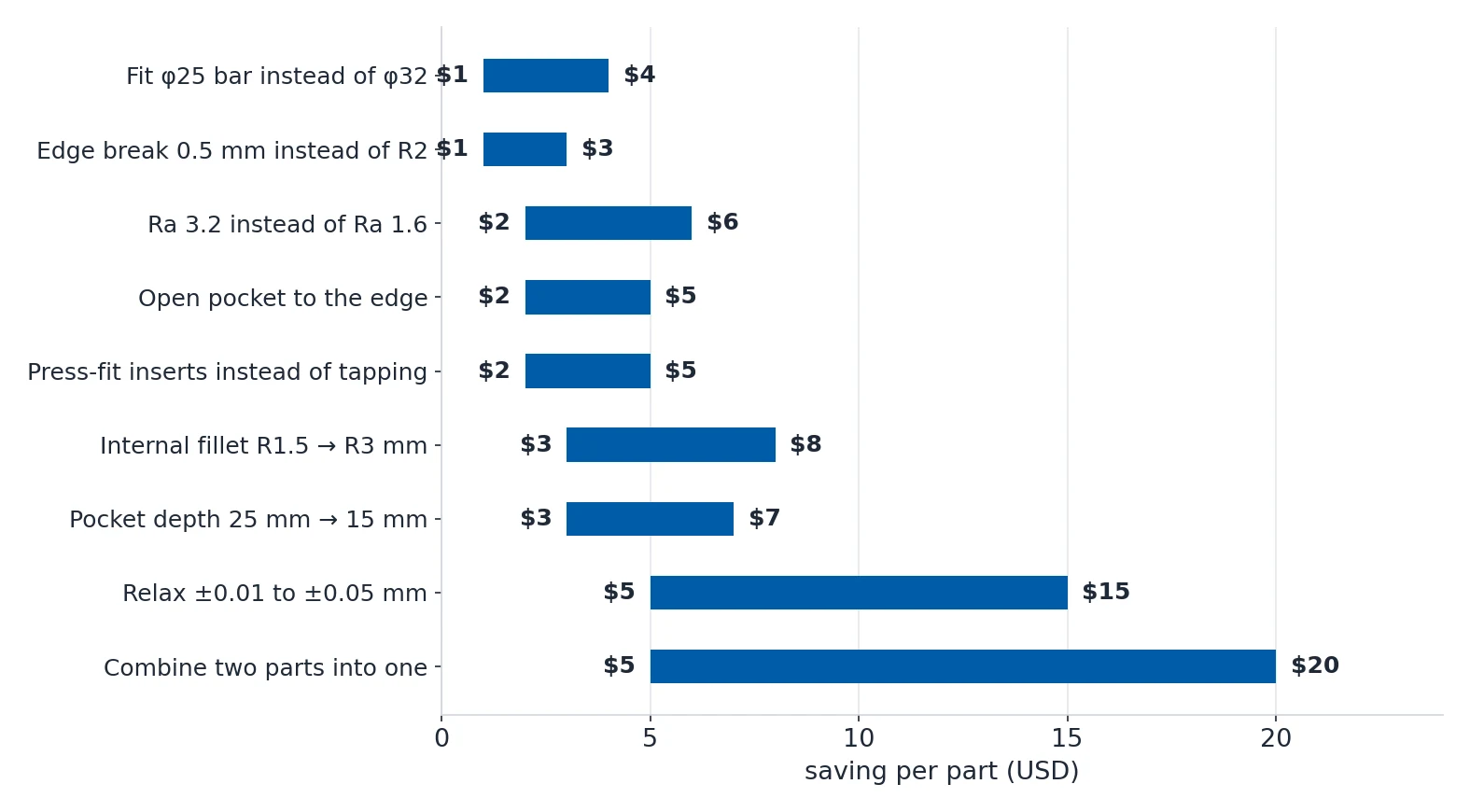
These change the drawing but not the part's function. Nine of them together, plus eliminating one setup, are worth $24–63 per part.
| Design change | Before | After | Estimated saving |
|---|---|---|---|
| Increase internal fillets from R1.5 to R3 mm | Small φ3 tool, 2 passes per pocket | Standard φ6 tool, 1 pass per pocket | $3–8 per part |
| Relax tolerance from ±0.01 to ±0.05 mm on non-critical dimensions | Finish pass plus CMM inspection on every dimension | Standard machining plus sampling inspection | $5–15 per part |
| Use standard surface finish Ra 3.2 instead of Ra 1.6 | Extra finishing pass, slower feed | Standard roughing plus one finish pass | $2–6 per part |
| Design the part to fit in φ25 bar instead of φ32 bar | Buy φ32 bar, machine away 40% of the volume | Buy φ25 bar, machine away 20% of the volume | $1–4 per part in material |
| Open the pocket to the edge and eliminate 3 closed pockets | Plunge and helical ramp into each pocket | Tool enters from the edge, no plunge needed | $2–5 per part |
| Reduce pocket depth from 25 mm to 15 mm | Long-reach tool, 4 roughing passes | Standard tool, 2 roughing passes | $3–7 per part |
| Combine two parts into one and eliminate the assembly | Two parts plus fasteners plus assembly labor | One part, slightly longer machining | $5–20 per assembly |
| Replace tapped holes with press-fit inserts on soft material | Thread milling 20 small holes, slow | Drill plus press-fit brass insert, fast | $2–5 per part |
| Break sharp edges at 0.5 mm instead of a cosmetic radius R2 | Ball-nose tool, slow contour pass on all edges | Chamfer mill, single fast pass | $1–3 per part |
| Eliminate one setup by moving features to one side | 3 setups: top, flip, side | 2 setups: top, side | $30–80 per batch in setup |
Some of these are about time rather than money, and they compound with everything above.
| Time-saving change | Detail | Time saving |
|---|---|---|
| Use the largest tool that fits | A φ16 mm end mill removes material 4× faster than a φ8 mm tool at the same feed per tooth. Always use the biggest tool the geometry allows. | 30–60% faster roughing |
| Standardize to fewer tools | Every tool change costs 15–45 seconds. A part using 12 tools spends 3–9 minutes on changes alone. | 2–10 minutes per part |
| Use carbide instead of HSS | Carbide runs 3–5× faster. The tool costs 2–3× more, but the time saving past a few parts is overwhelming. | 50–70% faster cutting |
| High-feed milling for roughing | High-feed cutters take shallow depth and wide step-over at very high feed rates. | 50–200% faster roughing |
| Reduce depth of cut where possible | A pocket 15 mm deep instead of 25 mm deep can use a stubbier, faster tool. | 20–40% faster per pocket |
| Avoid full-width slotting | A tool cutting a slot wider than its diameter is 100% engaged and generates maximum heat and vibration. Prefer circular interpolation. | 30–50% faster slotting |
| Open pockets to the edge | The tool enters from the edge instead of plunging. Plunging is slow and hard on tools. | 20–40% faster pocketing |
| Use larger internal fillets | Larger fillets allow larger tools. Changing pocket fillets from R2 to R4 can double the allowable tool size. | 30–60% faster pocketing |
| Reduce engraved text depth | 0.2 mm depth instead of 0.5 mm looks identical on most parts and cuts 60% faster. | 50–70% faster engraving |
When to Change the Process Instead of the Part
Sometimes the answer is not a better drawing but a different process. Decide this before the design is frozen, because a part designed only for CNC is locked into that cost structure for good.
| If your part has | Consider | Cost advantage over CNC | Break-even volume |
|---|---|---|---|
| Thin walls under 1 mm and a complex shape | Investment casting plus CNC finishing | 40–70% cheaper per part | 200+ parts |
| Large flat surfaces at low precision | Waterjet cutting | 50–80% cheaper per part | 10+ parts |
| Highly repetitive geometry, 1,000+ pieces | Die casting | 60–90% cheaper per part | 5,000+ parts |
| Small, simple, rotationally symmetric parts | Swiss-type automatic lathe | 30–50% cheaper per part | 500+ parts |
| A sheet metal shape under 3 mm thick | Laser cutting plus bending | 60–80% cheaper per part | 20+ parts |
| Internal channels and complex cavities | Metal 3D printing (DMLS or SLM) | Comparable at low volume, worse at high volume | 1–50 parts |
The same question has an answer for tooling. A custom fixture costs $200–1,000 and pays for itself at 200–500 parts. Dedicated form tools cost $100–500 and need 300–1,000 parts. A die-cast or investment-cast blank costs $3,000–20,000 and needs 500–2,000 parts, which is earlier than most people assume.
The Order to Do It In
The sequence matters, because each step is cheaper than the next one down.
- Fix the quantity first. Ordering 50 pieces once instead of 10 orders of 5 is the single largest saving available and it needs no design change.
- Make the part fit standard stock sizes, so the material scrap drops.
- Go through the drawing and delete requirements that were never needed: tight tolerances on non-functional features, Ra 0.8 on a surface nobody touches, R0.1 corners on a bracket.
- Check whether a cheaper alloy still does the job, and whether the function actually needs titanium or Inconel.
- Apply the small design changes that make the part faster to cut: bigger fillets, shallower pockets, pockets open to the edge, one tool radius.
- Only then consider fixtures, tooling or a different process, and check the break-even volume against your real annual demand.
Do steps 1 and 3 before anything else. They are free, they need no tooling, and between them they usually move the quote more than every other item on this page combined.
Sources
Every number on this page comes from our engineering wiki.