America Investigated Machine Tools and Robots, Found a Security Risk — and Imposed No Tariff. What the 180-Day Clock Means for Parts Buyers
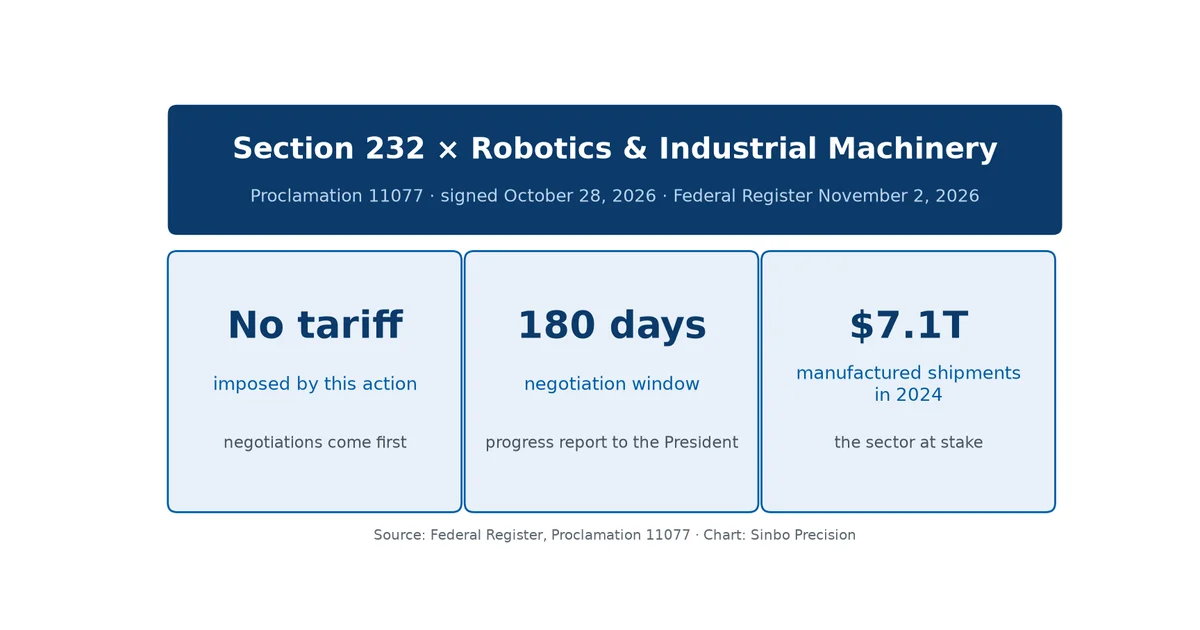
Proclamation 11077 (October 28, 2026): no new tariff on robotics, industrial machinery and parts — a 180-day negotiation clock instead, over a sector behind $7.1 trillion in manufactured shipments
The US Commerce Department concluded that imports of robotics, industrial machinery and their parts and components threaten national security. The presidential response, signed October 28, 2026, imposed no tariff — it started a 180-day negotiation clock. If you buy machined parts, here is what changed today (nothing), what may change in 180 days, and what to do with the window.
What the Proclamation Actually Says
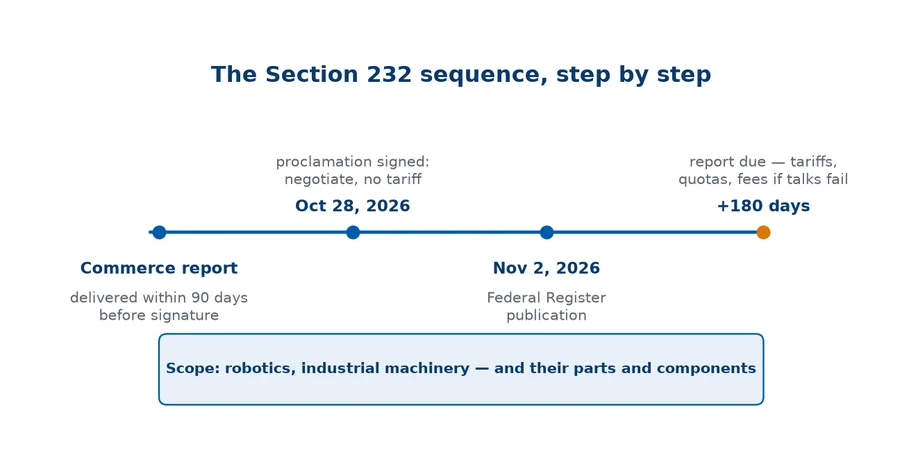
Proclamation 11077, signed on October 28, 2026 and published in the Federal Register on November 2, closes out a Section 232 investigation into robotics, industrial machinery, and their parts and components. The Commerce Secretary — whose report reached the President within the 90 days before signature — found that these imports "threaten to impair the national security of the United States". The scale cited is enormous: the sector sits behind roughly $7.1 trillion in US manufactured-goods shipments in 2024 and about $86 billion of equipment produced that year, touching all 16 US critical infrastructure sectors.
But the remedy is not a duty. The proclamation directs the Commerce Secretary and the US Trade Representative to negotiate agreements with trading partners, with a progress report due to the President within 180 days of the proclamation date. Only if an agreement is not reached, is not carried out, or proves ineffective does the President explicitly reserve the right to take other actions — tariffs, duties, quotas and fees are all named — alongside a program to incentivize US-based production.
Why a Parts Buyer Should Read Past the Headline
The covered subject is not just finished robots: it is "robotics, industrial machinery, and their parts and components" — repeatedly, in every operative paragraph. For a buyer of machined parts, that phrase does the work. If your company builds equipment — automation cells, machinery, robotic systems — and sources machined, fabricated or finished components from China for assembly into products sold into the US, those components sit inside the stated scope of a national-security finding, even though today nothing about their import treatment has changed.
The distinction to hold onto: a Section 232 finding of threat has been made and accepted by the President. A Section 232 remedy has not. No tariff rate was set, no tariff line was created, and nothing in the proclamation changes what you pay at the border this week.
Three Buyers, Three Readings
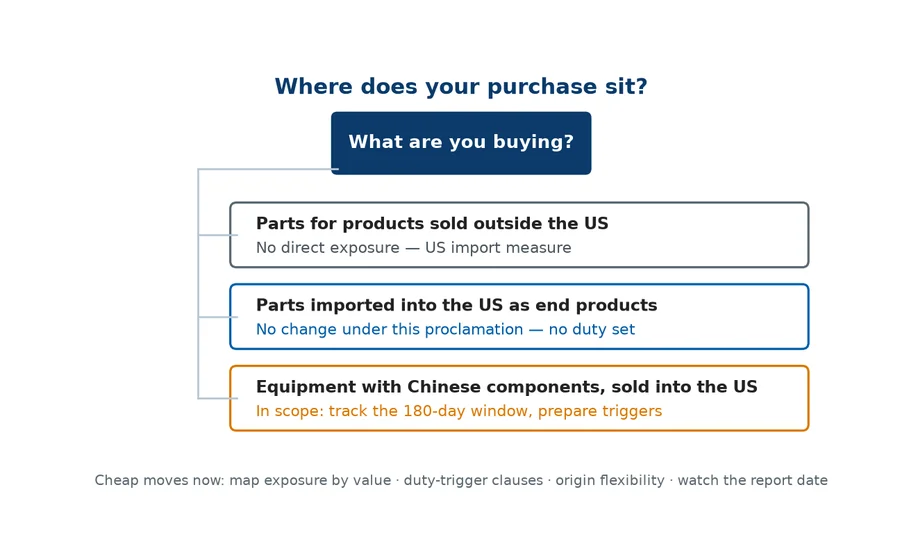
How much this matters depends on what you buy:
- You buy machined parts for products sold outside the US: effectively no direct exposure. This is a US import measure; your lane is untouched.
- You import machined parts or assemblies into the US as end products: no change now — this proclamation sets no duty. Your costs move on the schedules that already exist, not this one.
- You build machinery or robotic equipment with Chinese-made components and sell into the US: this is your regulation to watch. Your bill of materials is inside the finding's scope, and the 180-day window is when the rules for it get written.
How to Use a 180-Day Window
Windows like this are for preparation, not panic. Four practical moves for equipment builders in scope:
- Map your exposure by value, not by part count: list which purchased components are Chinese-sourced and what share of landed cost they carry — the list is your early-warning system when the report lands.
- Put a review trigger in purchase agreements: a clause reopening pricing if new US duties apply to the product category gives both sides certainty without renegotiating today.
- Ask suppliers about origin flexibility: which parts can shift production or final processing, and at what cost delta — knowing this before any announcement is worth more than knowing it after.
- Watch the calendar, not the headlines: the report is due within 180 days of October 28. Announcements about "possible tariffs" will outnumber real ones; the report is the fact.
The Honest Summary
A national-security finding now officially covers the machinery sector and its parts. The immediate remedy chosen is negotiation, which means the uncertainty is scheduled rather than resolved. For most machined-parts buyers, nothing changes this month. For equipment builders feeding the US market with Chinese-sourced components, the rational response is cheap: inventory your exposure, add contract triggers, and mark the 180-day report date on the calendar. The expensive response — rerouting supply chains for a tariff that may never come — is a decision for later, with better information.
Frequently Asked Questions
Does this proclamation add any tariff on parts or machines I import today?
No. Proclamation 11077 sets no tariff rate, creates no new duty line, and changes nothing at the border now. It records a national-security finding and opens negotiations. Existing duty schedules — including separate measures that already cover steel, aluminum and other goods — continue to apply exactly as before.
What happens when the 180 days are up?
The Commerce Secretary and the Trade Representative owe the President a progress report within 180 days of October 28, 2026. If negotiations have produced an agreement that is being carried out, the negotiated terms govern. If talks fail, stall, or produce something ineffective, the proclamation explicitly reserves tariffs, duties, quotas and fees as available next steps — so the report date is the moment of real information.
We build equipment with Chinese machined components for the US market. What should we do this quarter?
Three cheap moves: quantify the Chinese-sourced share of your bill of materials by landed value; add a duty-trigger repricing clause to purchase agreements; and ask key suppliers what origin flexibility exists and at what cost. None of these commits you to anything — they just ensure that if duties arrive, you learn your options in days instead of weeks.
Sources
- Proclamation 11077, "Adjusting Imports of Robotics, Industrial Machinery, and Their Parts and Components Into the United States" (Federal Register, Nov 2, 2026) — Signed October 28, 2026; Commerce report delivered within the prior 90 days; finding that imports threaten national security; remedy = negotiations by Commerce and USTR with progress report due within 180 days; tariffs/duties/quotas/fees explicitly reserved if no effective agreement; cites $7.1 trillion in manufactured-goods shipments (2024), $86 billion of equipment produced (2024), 16 critical infrastructure sectors.
- White House Fact Sheet, "President Donald J. Trump Adjusts Imports of Robotics, Industrial Machinery, and Their Parts and Components" (Oct 28, 2026) — Official summary of the proclamation and the negotiation-first approach.
This article summarizes a published presidential proclamation for general information. It is not legal, customs, or tax advice; classification and duty treatment depend on your specific goods — confirm with your customs broker or counsel.
Related Reading
US Machine Tool Orders Hit Their Third-Highest Month on Record
The demand side of the equipment cycle: record orders, tightening lead times, and five questions for suppliers.
Titanium Production Just Went Continuous
The materials side: a validated continuous titanium process pointing at a lower cost curve.
CNC Machining Services
Capabilities, tolerances and lead times for machined components, including export documentation.