Hot Dip vs Powder Coating vs Anodizing: Which Finish?
Pick the finish from the service environment first and the appearance second: hot-dip galvanizing for steel that must outlast the environment, powder coating for painted steel or aluminium in quantity, e-coating when the geometry hides surfaces from a spray gun, and anodizing when the part is aluminium and the oxide layer itself has to do the work. The four are not variants of one process — two of them add a film on top of the metal, one converts the metal into an oxide, and one grows a sacrificial zinc coating that keeps protecting the part after the surface is scratched.
The Short Answer: Match the Finish to the Service
| If your part… | Specify | Because |
|---|---|---|
| Is steel, outdoors, and must last a decade in a damp or coastal environment | Hot-dip galvanizing | The zinc is sacrificial, so it protects the steel even where the coating is scratched. |
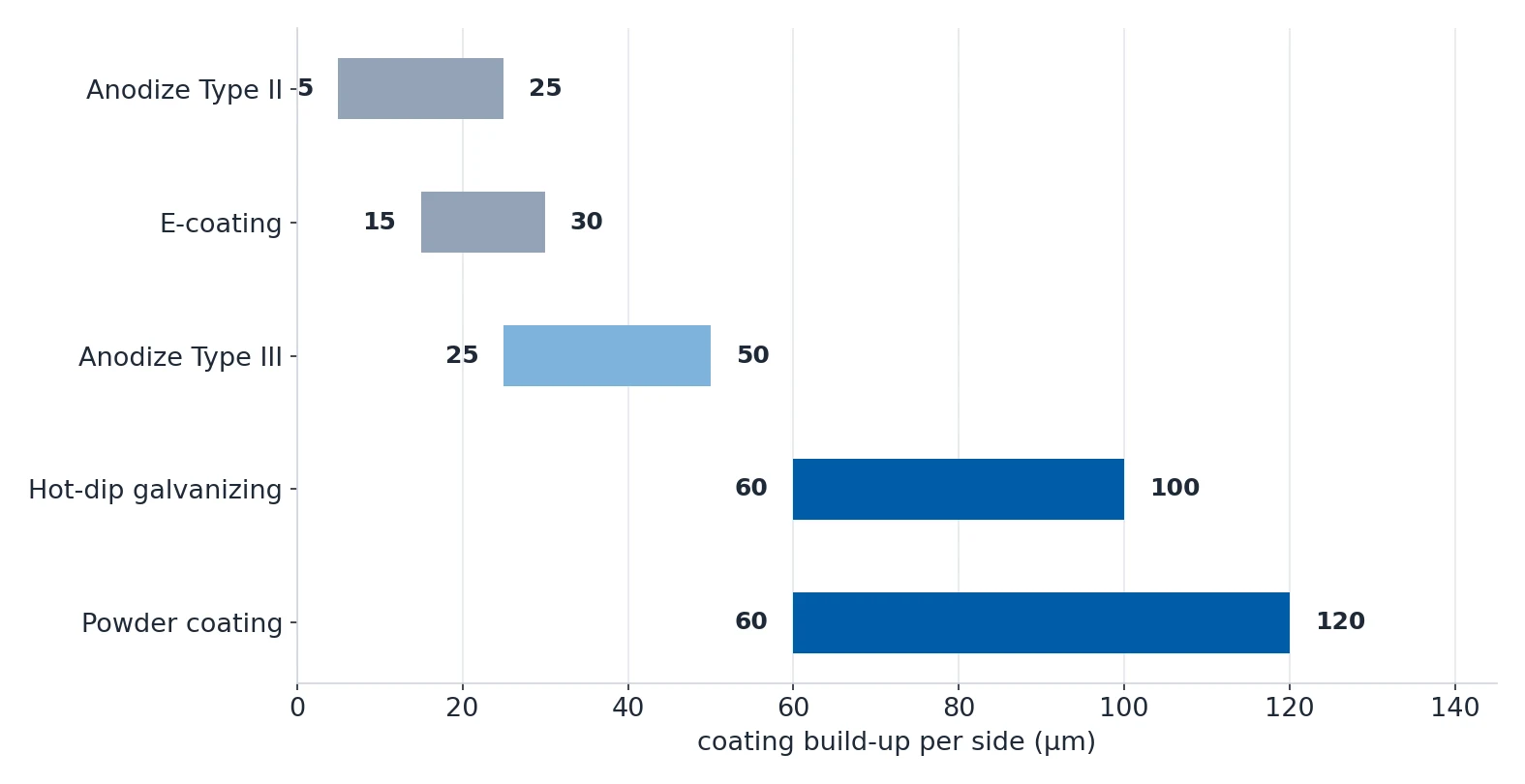
| Is steel or aluminium, flat panels, enclosures, brackets or frames, in quantities over 50 | Powder coating | The cheapest and most durable organic option, 60–120 µm at 1× baseline cost |
| Has internal surfaces a spray gun cannot reach, such as inside tubes and box sections | E-coating | It is an immersion process, so coverage is uniform at 15–30 µm |
| Is aluminium and needs wear resistance, dielectric isolation or a cosmetic colour | Anodizing | The oxide is grown from the metal itself, so it will not chip off like a film |
| Needs a metallic, pearlescent or candy finish, or a film under 50 µm | Wet paint | Powder cannot reproduce a true metallic effect and cannot go that thin |
| Is a casting with 5–12% silicon | Powder coating or e-coating | Cast aluminium does not anodize at all |

Two of those rows hide the decision that catches people out. Galvanizing and anodizing are not coatings in the ordinary sense — one adds sacrificial zinc that can be 60–100 µm thick, the other converts the aluminium into an oxide that grows both outward and inward. Both change your dimensions in ways a paint does not.
Powder Coating, E-Coating and Wet Paint: The Three Organic Options
Powder coating is electrostatic: powder is sprayed onto a grounded part, sticks, and is cured in an oven. It deposits 60–120 µm (2.5–5 mils) at 1× baseline cost, and the common target inside that window is 80–100 µm. Below 60 µm the coverage risks being insufficient, and above 120 µm you get runs and sagging.
E-coating is immersion, not spraying. The part is submerged in a bath and charged to 100–400 VDC, and the coating deposits uniformly at 70–90 °F for a film of 15–30 µm. That costs 1.3–1.8×, and it is the only one of the three that reliably reaches the inside of a tube or a box section.
Wet paint is the fallback. It is the only route to a true metallic, pearlescent or candy finish, the only one that goes below 50 µm, and the only one that works on non-conductive substrates such as glass-filled polymers. On runs under 50 pieces it is also the practical choice, because powder coating carries a minimum lot charge.
Hot-Dip Galvanizing: When Steel Needs to Outlast Everything
Hot-dip galvanizing is the only option here that protects a part after the surface is damaged. The steel is dipped in molten zinc at around 450 °C, the zinc reacts with the iron to form an intermetallic layer, and the remaining zinc sits on top as a sacrificial layer that keeps protecting the exposed steel as it corrodes.
That is why galvanizing is the default for outdoor steel: exposed cut edges and drilled holes are protected by the same sacrificial mechanism, which no paint or powder film can offer.

The catch is dimensional. Galvanizing builds 60–100 µm plus the process allowance on each surface, the largest effect of any finish here, and it is the one that most often breaks a fit.
| Point of failure | What galvanizing does to it | What to do |
|---|---|---|
| Threaded holes | The zinc fills and swells the thread, so the fastener no longer fits | Mask the threads, or oversize and re-tap after galvanizing |
| Press fits and bearing bores | The bore closes by the full coating thickness | Machine after galvanizing, or specify the allowance |
| Sharp internal corners | Zinc pooling leaves a thick, brittle edge | Specify a 0.020–0.040 in fillet radius on internal corners |
| Cut edges from laser or plasma | The edge burns off zinc during cutting and starts rusting within weeks | Specify edge sealing or a powder coat over the zinc, or accept bare edges for indoor use only |
Galvanized sheet also has one property worth knowing before you design a bracket from it: zinc burns off at the laser cut edge, so the edge needs protection if the part is exposed.
Anodizing: The Aluminum-Only Option That Grows Into the Part
Anodizing is not a coating. It is a conversion process: the part is the anode in a sulfuric acid bath, current converts the surface aluminium into aluminium oxide, and the oxide layer grows outward and inward at the same time. Roughly half the coating adds above the surface and half consumes the base metal, so a diameter changes twice the coating thickness.
| Anodize type | Process | Thickness per surface | Hardness | Dielectric strength | Salt spray |
|---|---|---|---|---|---|
| Type II (commercial) | 15–20 VDC, sulfuric bath | 0.2–1.0 mil (5–25 µm) | 250–350 HV | 200–400 V/mil | 336+ hrs at 25 µm |
| Type III (hard) | 25–60 VDC, bath at 0–5 °C | 1.0–2.0 mil (25–50 µm) | 400–600 HV | Higher | Highest |
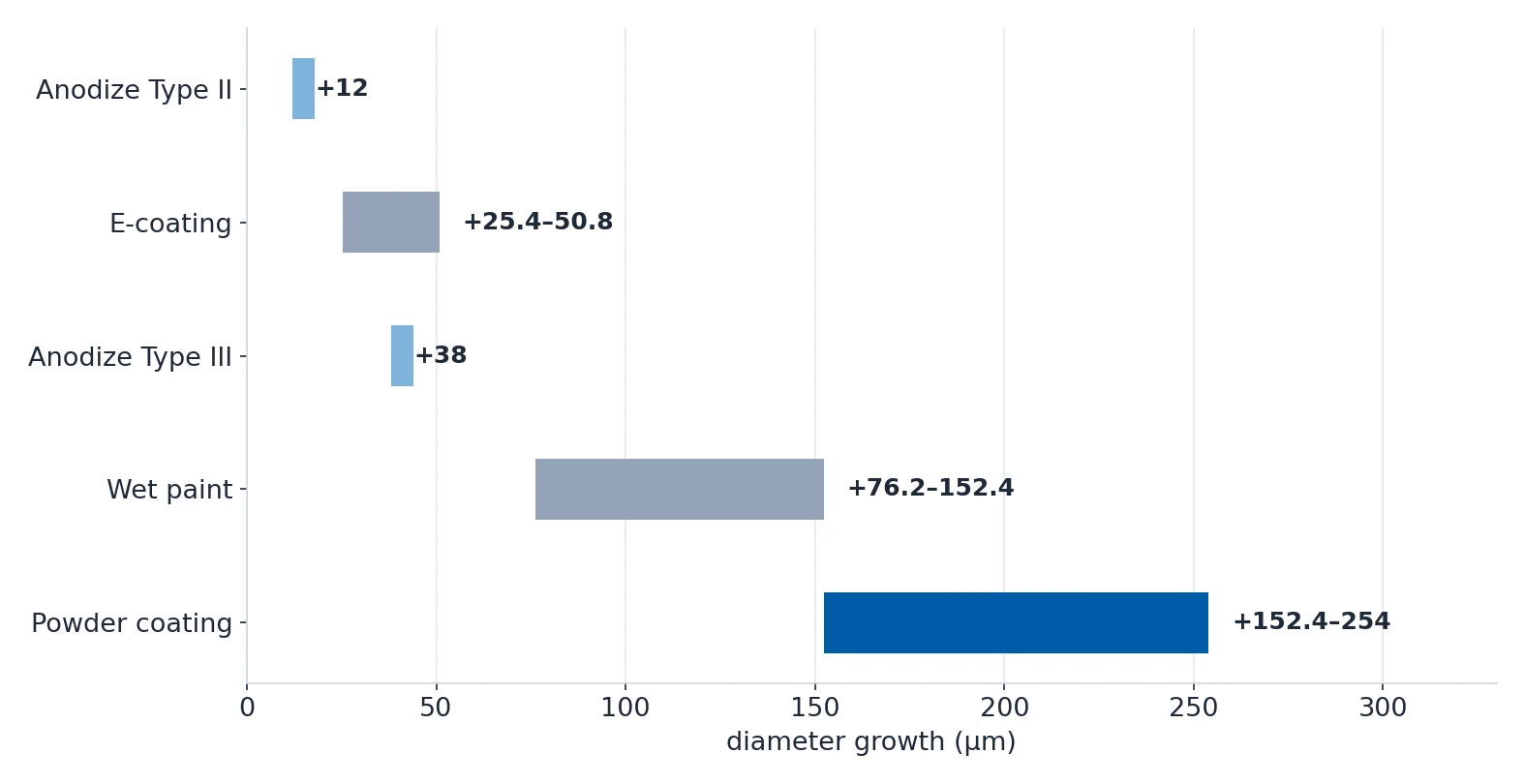
The consequences follow directly from that table. Type II at 0.5 mil (12 µm) adds +0.25 mil per surface, or +0.5 mil (12 µm) across a diameter; Type III at 1.5 mil (38 µm) adds +1.5 mil (38 µm) across the diameter. Press-fit bores such as H7/p6 and bearing journals are high risk, and threaded holes need pre-sizing or post-anodize chasing. Either put the growth into your tolerance stack, or mask the feature.
Type III is worth the extra only if you can name a wear requirement. It costs 1.5–2× more than Type II, adds 3–5 working days of lead time, and comes only in dark grey, brownish-black or bronze, because the dense oxide will not absorb a dye.
Anodizing and Alloy Choice Are Not Separate Decisions
The alloy settles the anodize quality before anything else, because copper content controls how cleanly the oxide forms.
| Alloy | Copper content | Anodizing result |
|---|---|---|
| 6061-T6 | 0.15–0.40% | Excellent for both Type II and Type III, with the best colour quality |
| 7075-T6 | 1.2–2.0% | Type III is only fair, the hard coat is brittle and can flake, and the colour is poor |
| 2024-T4 | 3.8–4.9% | Not recommended for Type III |
| Casting alloy | 5–12% silicon | Does not anodize at all — specify powder coating or e-coating instead |

Colours have their own cost ladder. Clear and black are standard everywhere at no extra charge; blue, red and gold cost a slight premium and look their best on 6061, though red needs a coating of at least 0.5 mil or it shifts pinkish. Orange and purple need a specialty shop and add 10–20%, and a custom Pantone match needs a lab dip, batch minimums and 30–50% or more in setup.
What to Write on the Drawing
Writing only "anodize" lets the shop apply its own default, which may be too thin for your service or too thick for your tolerances. The same applies to coating: gloss is a number, not a word, and colour is a code, not a photo.
| Finish | What to write | Notes |
|---|---|---|
| Anodize Type II | TYPE II, CLASS 1, 0.0005 IN MIN | Name the seal: nickel acetate to MIL-A-8625, or hot deionized water with no nickel for food and medical parts |
| Anodize Type III | TYPE III, 0.002 IN MIN PER MIL-A-8625 TYPE III | Dark grey, brownish-black or bronze only |
| Powder coat | Coating type, dry film thickness, gloss band, RAL or Pantone code | Gloss runs 5–95 GU: matte 5–20, satin 30–60, semi-gloss 60–80, full gloss 80–95 |
| E-coating | Film thickness and colour, plus any masking | Immersion process, so internal coverage is inherent |
| Hot-dip galvanizing | Coating designation, plus thread masking and any dimensional allowance | Largest dimensional effect of the four |
| Pre-treatment before coating | ABRASIVE BLAST TO SA 2.5, IRON PHOSPHATE, DRY BEFORE COATING | Degrease at 140–180 °F and dry at 100–120 °F so trapped water cannot blister during the cure |
Two more details decide whether the parts come back right. Hot-rolled steel must always be blasted, because coating over mill scale fails with it. And add a 0.020–0.040 in fillet radius to internal corners, or the powder pulls away and leaves thin or bare spots.
What Each Finish Costs and How to Bring the Price Down
Coating price is driven by setup and logistics rather than by material, so quantity and part design do most of the work.
| Cost driver | Number |
|---|---|
| Powder coat minimum lot charge | $50–200 |
| E-coat minimum lot charge | $100–500 |
| Anodize setup charge | $50–200 |
| Masking a critical bore or thread | $2–8 per part |
| Each extra coat in a multi-coat system | +50–100% |
| Rush orders | +25–100% |
| Custom Pantone match | $200–500 setup plus a 20–50 kg minimum order |
| Booth colour change | $50–200 per change |
| Special anodize colours (orange, purple) | +10–20% and a specialty shop |
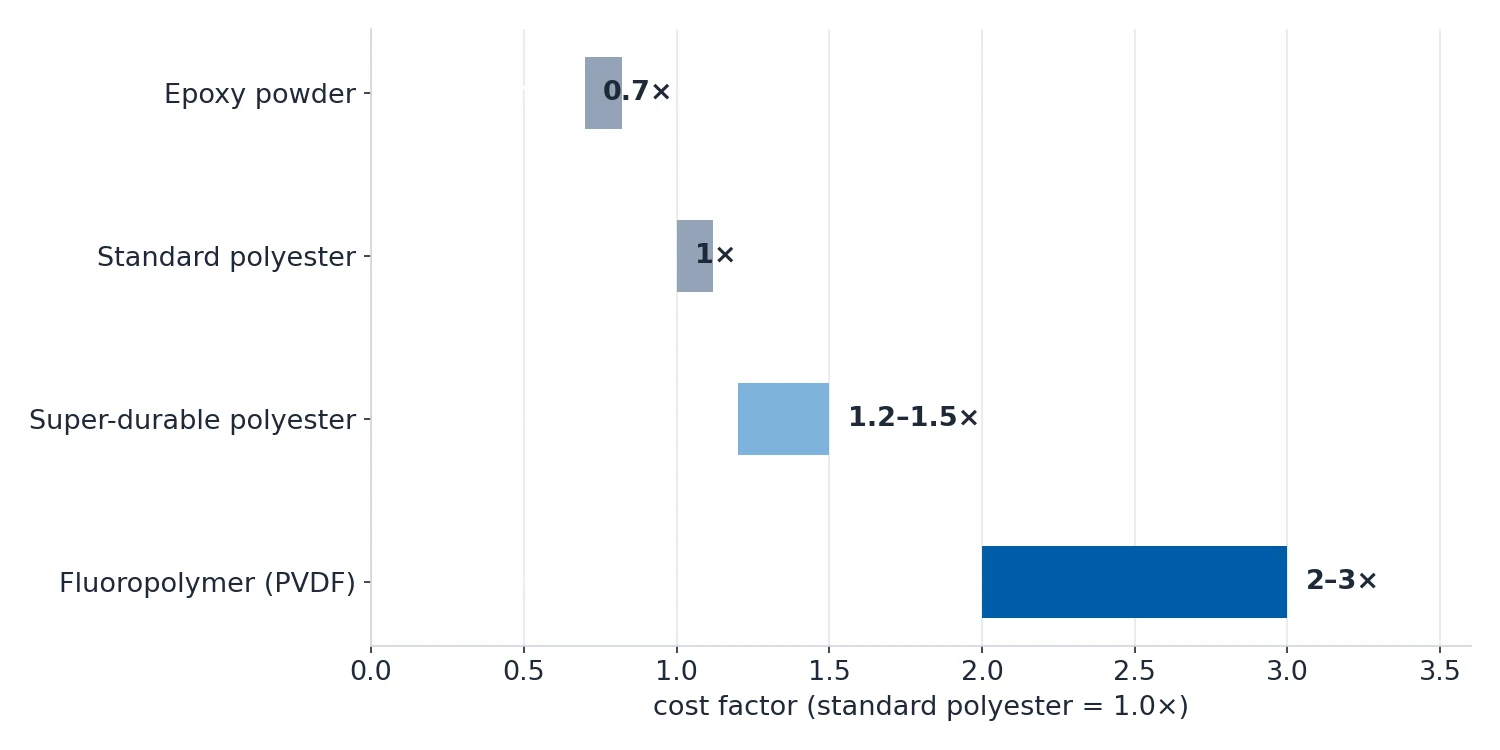
| Super-durable polyester instead of standard | 1.2–1.5× |
| Fluoropolymer (PVDF) | 2–3× |
| Hard anodize (Type III) instead of Type II | 1.5–2× and 3–5 extra working days |
On a small order the setup charge dominates the per-part price. Per-part cost at 100 pieces is typically 40–60% of the cost at 10 pieces, and at 1000+ pieces it falls to 25–40%. Batch quantity is therefore the single biggest lever you control.

The practical order of decisions is short. Decide the service environment, pick the finish from the table at the top, write the film thickness and the seal or the powder type on the drawing, add the coating build-up to your tolerance stack, and only then pick the colour.
Sources
Every number on this page comes from our engineering wiki.