US Machine Tool Orders Just Broke $1 Billion in a Single Month — a First. Which Parts of the Record Are a Pulse, and Which Are a Trend?
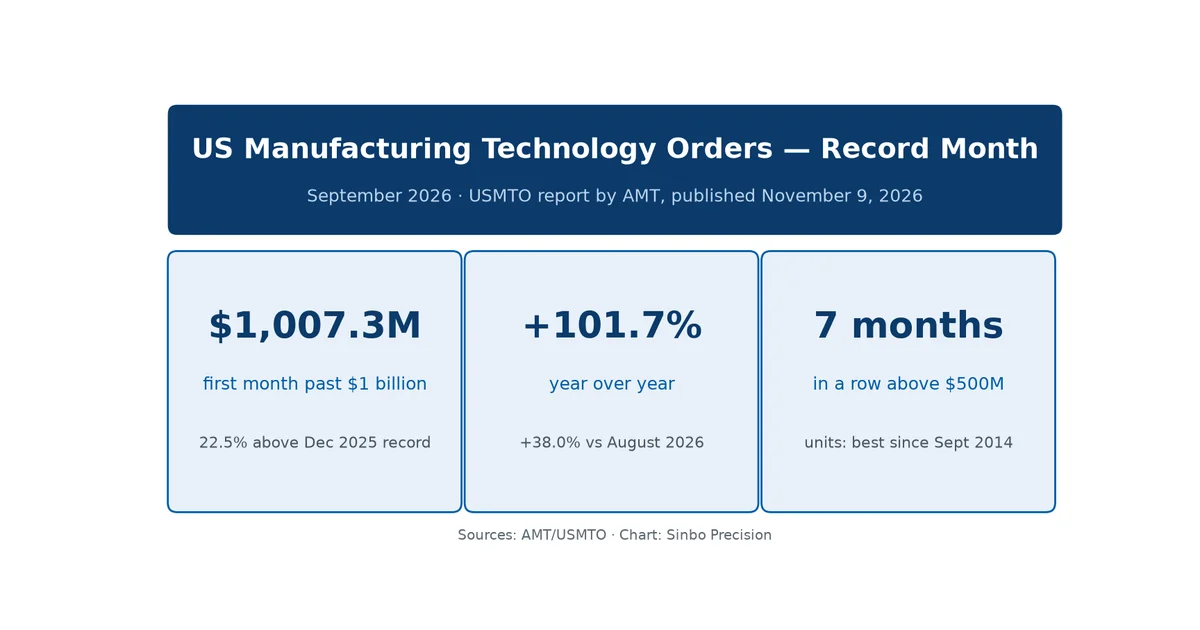
US manufacturing technology orders, September 2026: $1,007.3M — a record month, 22.5% above the previous December 2025 high, and the seventh consecutive month above $500 million
US manufacturing technology orders reached $1,007.3 million in September 2026 — the highest month ever recorded and the first past $1 billion, up 101.7% year over year. Some of that is the IMTS show pulse. But underneath it, job-shop orders broke their own record by almost 25% — and that part is a capacity trend parts buyers will feel through 2027.
The Record, in Numbers
According to the USMTO report published by AMT on November 9, September 2026 orders of metalworking machinery totaled $1,007.3 million — up 38.0% from August and 101.7% above September 2025, and 22.5% above the previous monthly record set in December 2025. That makes it the first month ever past $1 billion in the report's history. The streak also extended to a seventh consecutive month above $500 million — the longest on record — and machine unit counts reached their highest level since September 2014.
Pulse or Trend? Read the Structure, Not the Headline
Every IMTS year produces a September bump — the show concentrates deals that would otherwise spread across months. That is the pulse, and it will fade from the October numbers. Three things in this report are not pulse:
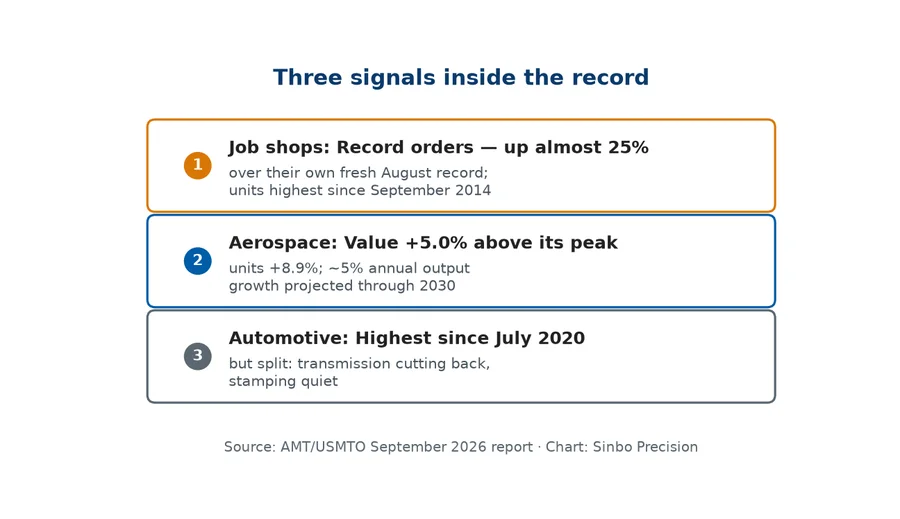
- Job shops broke their own record by almost 25%. In August they grew faster than the market for the first time this cycle; in September they set an all-time high while buying machines with less automation content — meaning ordinary contract shops, the shops that machine parts for customers like you, are adding capacity.
- Unit counts at their highest since September 2014. If only large OEMs were buying expensive automated lines, value would rise while units stayed flat. Units rising means the buying base is broad.
- Aerospace set new highs in both value (+5.0%) and units (+8.9%), with Oxford Economics projecting roughly 5% annual output growth through 2030 — a structural, multi-year climb, not a show-month artifact.
The mixed signal is automotive: highest orders since July 2020, but with transmission makers cutting back after a long investment run and stamping staying quiet. One sector cooling inside a record month is normal — it is not the story.
What It Means for Parts Buyers
AMT's own outlook is that orders could remain elevated through the end of 2026 and into 2027, supported by automation interest, backlogs, and defense activity. For a buyer of machined parts, the practical reading of a record like this has three parts:
- The 2027 capacity wave is now visible. Machines ordered in this streak arrive and qualify through 2027. Shops that ordered early will have new capability while everyone else still queues — the suppliers to grow with are the ones who can tell you what they ordered and when it lands.
- Quote behavior splits by shop type. Job-shop capacity additions eventually ease lead-time pressure on standard work; OEM-directed automation tightens the market for high-end 5-axis time in the meantime. Ask which side of that split your part lives on.
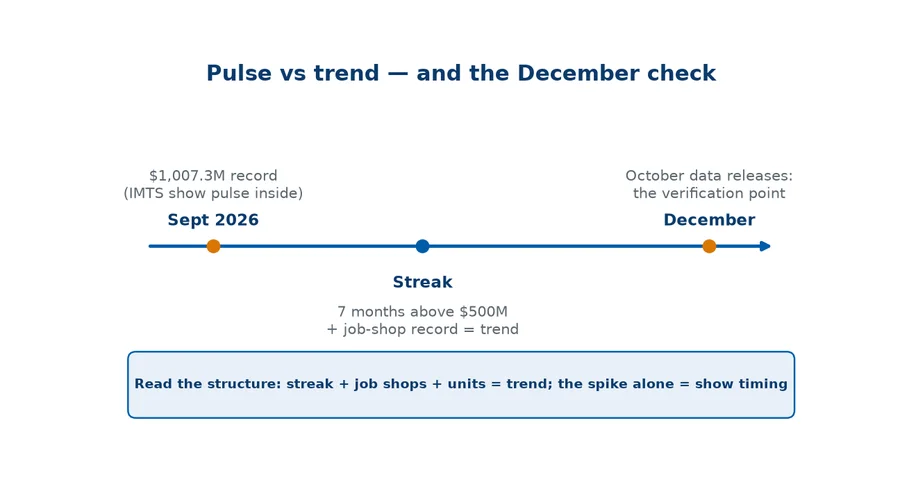
- The verification point is already scheduled. October's numbers publish in December. If October holds well above $500 million after the IMTS pulse washes out, the trend interpretation is confirmed; a deep pullback would say the record was mostly show-floor timing.
The Honest Summary
A first-ever $1 billion month is a milestone, but milestones do not ship parts. What ships parts is the mix underneath: contract shops expanding at record rates, aerospace demand climbing on a multi-year path, and enough breadth that unit counts hit a twelve-year high. Buy on today's capacity, weight your suppliers by how precisely they can describe what they have on order, and mark December on the calendar — the October report will tell you whether this record was mostly a very good trade show, or the start of a genuinely bigger machine base.
Frequently Asked Questions
Is the record month just the IMTS effect?
Partly, yes — shows concentrate orders into September, and October figures will likely fall from $1,007.3 million. But three elements are not show-floor timing: job-shop orders beating their own fresh record by almost 25%, unit counts at their highest since September 2014, and aerospace setting highs in both value and units with third-party forecasts of about 5% annual growth through 2030. The pulse fades; those do not.
Should I expect machining lead times to improve in 2027?
Directionally, for standard work, yes — the machines ordered in this streak arrive and qualify through 2027, and job-shop capacity additions are exactly the capacity that takes outside parts work. But high-end configurations stay tight longer, because OEM-directed automation absorbs that end of the market first. Split your expectations by the type of work your parts need.
What should I ask my supplier after this report?
The same five questions from our August analysis, with one upgrade: ask which of their machines are on order from this record streak and when each one reaches qualified production. A supplier who can answer with dates is telling you they are part of the trend; one who cannot is telling you they will be competing for the same tight capacity as everyone else.
Sources
- AMT, "IMTS Drives Manufacturing Technology Orders Past $1B in September 2026" (Nov 9, 2026), via Industrial Machine Trader reprint (Nov 11, 2026) — September 2026 orders $1,007.3M (+38.0% MoM, +101.7% YoY), 22.5% above the December 2025 record — first month past $1 billion; seventh straight month above $500M; units highest since September 2014; job-shop orders almost 25% above their own August record; aerospace value +5.0% above peak, units +8.9%, Oxford Economics ~5% annual growth through 2030; automotive highest since July 2020 but mixed; AMT outlook: elevated through end-2026 into 2027.
- AMT — USMTO press releases (amtonline.org) — Official index of USMTO monthly reports; October 2026 data scheduled for release in December 2026.
USMTO figures reflect data reported by program participants. Order data is a leading indicator of capacity investment, not a price forecast; treat it as one input among several in sourcing decisions.
Related Reading
US Machine Tool Orders Hit Their Third-Highest Month on Record
The August analysis that started this series: what an equipment boom does to lead times, and the five questions to ask any supplier.
No New Tariffs on Machine Tools and Robots — Yet
The policy side of the equipment cycle: a 180-day negotiation clock over machinery imports and parts.
Titanium Production Just Went Continuous
The materials side: a validated continuous titanium process pointing at a lower cost curve.